I’m taking a moment to share some last minute details and FAQs.
If you have signed up for the challenge, you should start receiving writing prompts by email just after midnight (Eastern US). If you haven’t, you can sign up here.
If you haven’t been through the prep tasks, don’t fret. You can dip into them any time you get stuck, to shake things up. Find them all here.
Each day, you should read the prompt and decide if you want to play with it or write something completely different. Try to start and finish a story every day that you’re writing. (If you ‘miss’ a day, don’t try to catch up. Just keep showing up.)
Come back to the prompt when you’ve written and leave us a comment, letting us know how it went. Don’t post your story, but do feel free to share a line you loved or tell us what you learned.
Something New
A couple of years ago I provided an optional Challenge Handbook, with daily warm up and brainstorming exercises, tailored to each prompt and I’m doing it again this year.
Here’s what people have said about these exercises:
“The brainstorm exercise in the Handbook rocketed me directly into a draft of the story (thanks, Julie!)”
The Warm-Up helps me get the page “dirty”….
The Brainstorming page is where a lot of my ideas are generated. If I already have an idea, then it helps me flesh out my plan…
This year the Handbook is available as a private podcast with written transcripts. It’s just a dollar a day during the challenge, with the option to donate more if you like. (The price will go up in June.)
Get the StoryADay Challenge Handbook for 2026 – custom warm-up and brainstorming exercises for every prompt, delivered as a private podcast with transcripts. SUBSCRIBE NOW
There’s a lot going on in the world today. AI, publishing worries, the world…the feeling that writing is somehow not as ‘important’ as any of that.
Bah!
In this week’s podcast episode I make the case that it’s absolutely the time you should be writing — not because I can guarantee you publishing deals, awards, cash, or screaming fans, but because the act of creation matters.
And then, because it’s October, I’m giving you pointers on how to write a spooky story (and no, you don’t have to like horror, for, or long, dark staircases.) I’ll show you how to take an extremely ordinary premise and make it deeply unsettling, by changing just a few details.
In This Episode
00:00 Why “a good idea” can stop you before you start
00:17 October, spooky stories — and why I want you writing
01:03 Why writing still matters when the world feels noisy
03:30 Why external success won’t sustain your writing life
07:10 Writing as an antidote to cynicism 10:09 Why finishing stories matters
10:09 StoryADay November is coming 11:30 The trap of waiting for a good idea
13:30 How to turn an ordinary idea into a spooky story
15:30 Use setting, isolation and sensory details
17:00 Make one thing feel slightly wrong
18:00 Repetition, unease and psychological spookiness
19:00 What has your character done to deserve this?
20:00 Your spooky story challenge If you’re inspired to write, don’t go and try to learn anything else.
In which I caution you against looking for answers in the wrong places….
Back in the mists of time, when I worked in an office–before remote working, before video conferencing—we worked together, but separately, each in our own little cubicles.
From time to time we got up and wandered over to the coffee machine for sustenance—both of the caffeine variety and the human variety.
You’d see someone, ask about their day, laugh about shared customer-challenges, and wander back to your desk refreshed.
It worked because you were seeing people who shared common experiences (You knew the aims of the company, who the good bosses were, and that nobody should ever reheat fish in the office microwave).
Early online communities and social media were like that…but for stuff you actually did for fun.
Twitter, in 2007, was the online equivalent of the office coffee machine, but for writers and other freelancers who worked alone for most of the day; for people who knew nobody else in their zipcode who was still mourning the cancellation of “Firefly”; and where people with the same twist to their sense of humor could find each other.
So why doesn’t StoryADay have a free community, like so many other writing sites?
Well, when I started StoryADay in 2010 it actually did have a free community (a Buddypress forum that felt a lot like a Twitter feed), but it was hard to lock out the spammers, so I shut it down and went back to asking people to leave comments on blog posts.
Here in 2026 I still ask people to check in by leaving comments on blog posts, which feels impossibly retro now and yet, and yet…
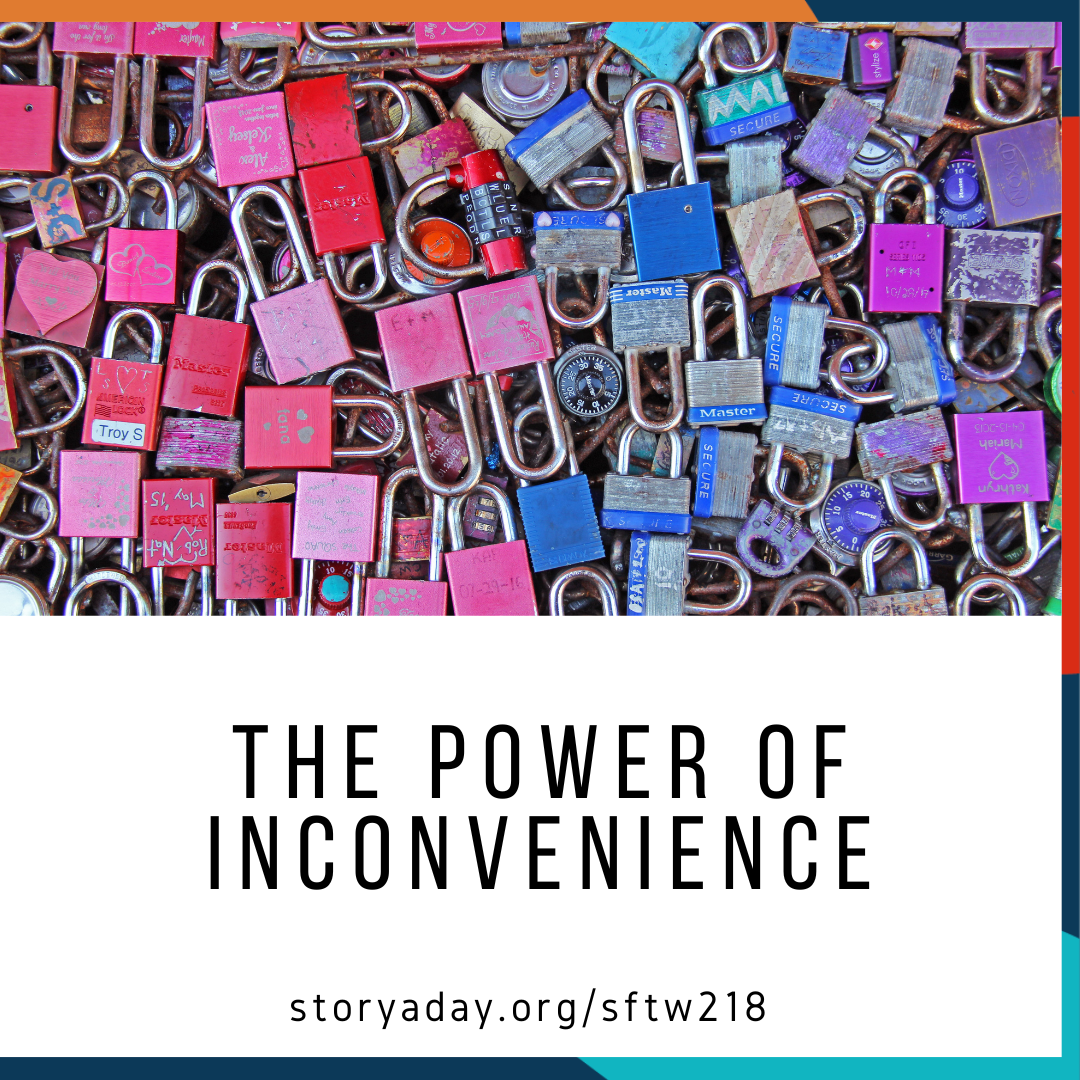
I’m increasingly coming to believe in the power of inconvenience.
If someone replies to your blog comment, you have to make the effort to come to the site and find it to reply to it.
It doesn’t pop up on your phone and pull you away from whatever you were thinking about a moment ago. You have to set aside time to pull up StoryADay.org and find the post and see if anyone replied.
You can choose not to.
And if you choose not to, what have you really lost?
I, as the host of StoryADay, have lost the opportunity to hook you into my platform day and night, and so, StoryADay has never gone viral, never had a splashy influx of hundreds of thousands of users, never had companies beating down the door to sponsor posts.
And, equally, we’ve never had any problems with bad behaviour, or people losing days–or weeks–to feuds and drama.
What we have had is thousands of writers who drop by to be inspired by a prompt, share a cheery word of encouragement with another writer, or leave a comment to tell me a story they started during a previous StoryADay May is just about to come out in XYZ Magazine.
Maybe I should have built an addiction machine, where I could sell my captive audience into ever-more-expensive programs until I could hire a bunch of coaches to replace me and retire to a windswept island off the coast of Scotland.
At any point, I could have hosted a message board or forum at the site, started a Facebook group or a sub-Reddit, formed a Patreon, or a MightyNetwork, or a Skool, a Substack or a Discord (I mean, doesn’t everyone have a Substack or a Discord, now?)
But, it has always come back to this:
My aim is to encourage you to write more.
And I’ve never been able to convince myself that creating a fun place for you to hang out in your spare time, instead of writing your next story, was my best move.
(And I certainly didn’t want to spend all my time moderating comments.)
But what about your Superstars Group, I hear you ask; don’t they have a community?
There aren’t very many of us (Superstars will never have more than 150 people in the group, and I suspect the sweet spot is somewhere under 100), so everyone feels seen.
We all share the same experiences: writing sprints, workshops, critique weeks, hangouts and coaching
We all understand the group’s aims: to get us all writing more, and feeling more successful.
People have made a commitment, in order to be there. By paying a membership fee they have said to themselves: I am a writer. I take this seriously.
It’s fun to pop in and leave a comment or answer a question, and get that deep sense that, no you are not the only one who struggles with this or that aspect of the writing life.
But the chatter is never overwhelming.
Just like when I was back at the office, I think we feel the peer pressure of the group subtly saying, ‘ok, that was fun, but isn’t it time to get back to work, now?’
Why am I telling you this?
In part, because I wonder if you think it’s strange that I don’t have a more modern way for you to connect with other writers, and why the most effective way is behind a paywall.
But mostly, I hope you’ll heed this warning: there are a million and one writing communities out there, of varying quality. Some are free. Some promise the world. Some will suck the life right out of you and most will eat all of your free (aka ‘writing’) time.
If you find yourself in writing Discords or Substack communities, or Facebook groups that don’t propel you away from the group, inspired to write; and instead you just keep scrolling, scrolling, scrolling…I’m going to suggest that you step away.
Maybe just for a day or two. Try it out.
Trust me when I say:
You don’t need another tip on how to write dialogue.
You don’t need to know who’s saying what about AI this week. You need to write your next story.
You need to finish that chapter.
You might need to go and read a real book, to get inspired.
Or perhaps you need to go outside and feel the wind on your face, and gaze into the deep blue of the twilight sky for an unreasonably long time, and be struck, once again, with awe at your speck-like existence in this improbable, ridiculous universe.
This is what I remind myself every time I see another writer, or writing teacher, offering an invitation to their free Discord and wonder, “Should I be offering that too?”
And this is what I hope you’ll remind yourself any time you are temped to go online to find the answer to a question that you know, deep down, can only be found inside yourself, and birthed into the world through the process of you fumbling your way through drafts, and revisions, and through the messy, frustrating joy of this thing we call writing.
Actually-writing harder than scrolling a ‘community’ feed. It’s scarier. And, in the end, sweeter.
I got another great question from the StoryADay community this week and I thought you might be interested in eavesdropping on my answer.
But first, in Notes from Julie’s Desk, I’m going to confess that my own ambitions for One-Story September were derailed by sickness.
Now that I’m on the mend, however, I can definitively assure you that—even if you start late—the One-Story method is paced to make sure you can still succeed. (Here on Day 5 I’m still fleshing out my story idea, but it’s proving extremely motivating to know I still have 25 days to work on this story, and a guided process to keep me on track. Want to join us? You can still do that, here.)
How To Choose What To Write
The question, paraphrased, was,
“I have so many ideas. How am I supposed to pick which one to work on? Or should I maybe try to incorporate them all into one piece? I don’t know…and then I get paralyzed.”
Sound familiar?
My answer went something like this.
Firstly, good for you for diagnosing the problem—that’s Step 1 in finding a solution.
Secondly, this probably is much more common than you probably think.
I firmly believe it’s one of the reasons a lot of writers get more done during challenges like StoryADay and when they have an upcoming deadline for a writing contest or themed anthology: the lack of choice is freeing.
OK, but without an external voice forcing your hand, how DO you choose?
The first thing to understand is that any choice you make is only a choice for now.
That’s certainly easier to live with (especially during something like One-Story September) than the idea that you have to make the right choice, for all time.
Choose.
Experiment.
Examine what happened (and how you felt about it), and then
Make another choice and run another experiment.
Does that really work?
“Creativity is not some privileged kind of thought free from constraint. Rather, it is normal problem-solving, just directed at a specific and interesting problem.” – Herbert A. Simon, quoted in Inside The Box by David Epstein.
This is both key and incredibly encouraging. Talent is not required. Genius is not required. A world-changing inspirational idea is not required. Just a problem that interests you, and your willingness to keep noodling on it.
There is no ‘right’ answer to ‘what should I write?’. Ever.
There are only these questions:
What specific idea do I find interesting, right now?
Can give it to a character and have it cause problems for them?
Can I sustain my interest in solving each subsequent wrinkle created as my character begins to tackle the main problem…until I reach the end?
Bonus tip: you won’t know if the answer is ‘yes’ until you get out of the abstract thinking phase and into the concrete ‘ideas on paper’ stage.
A short story—even a novel—has an end. The process of writing it has an end.. Any story you start should not become a life-long project.
You are experimenting. You are problem-solving.
So just pick something, and throw problems at your characters until they are smart enough to solve them (potentially happy ending), or have demonstrated that they can’t (potentially bleak ending).
Final caveat: the lure of the new idea is strong, especially when the problem-solving in your current project gets hard. Resist the urge to believe that you’re missing out on a ‘better’ idea, or a better story and abandon the one you’re working on. There’s nothing wrong with switching between projects if that makes your brain happy, but don’t believe the lie that there is a perfect idea, a perfect story out there waiting for you. Just keep solving problems.
Keep writing,
P. S. I’m serious: if you want to be writing and could use a framework to get you through this month, consider jumping in—fashionably late—to the One-Story Challenge.
How do you choose what to write? Does your method differ? Leave a comment here, and let me know.
If you’re here because you clicked through from my email saying: ‘interested in writing One Story along with me, thanks! Leave a comment, letting us know why you are excited about focusing on one story, for a month, or what you’ve achieved in past challenges.
“But I want to write novels! Why do people keep trying to get me to write short stories?!”
I hear you.
I used to simply answer: “If you don’t want to write short stories, you don’t have. Go, write your novels. Be free!”
Learning About Learning
Then I watched as thousands of writers struggled to get past the 30% mark of their novels, and got discouraged.
And I went and learned a few things about how we, as humans learn.
Turns out: it’s all very well to try new things, but unless you’re able to observe the consequences of your actions, you can’t know if what you’re trying is working.
Telling a story over the course of a novel might take you months or years.
Telling a story over the course of a short story is much faster.
You get to see and feel what ‘idea generation’, and ‘writing a bold beginning’ and ‘getting through the middle’ and ‘managing the turn towards the end’ all feel like.
You begin to be able the feel a story taking shape and tell if it’s correctly proportioned.
You get to find experiment with different styles and genres
You get to find out–more often and more quickly–what readers experience when you write different types of stories, characters, endings, and language.
In short, you develop your craft skills more quickly when short stories are part of your practice because you:
Experiment more often and more freely,
Experience the consequences of those experiences for your characters, stories, and readers.
Can adjust course or abandon experiments more often, and try something new.
And don’t even get me started on the value of a having ‘low cost of entry’ ways for new readers to experience your writing and discover they love you; or the marketing options that open up for you if you have ‘teasers’, ‘interludes’, or ‘reader magnets’ in short form, to invite readers in or keep them interested while you’re finishing off the next novel.
You Don’t Have To Love Short Stories…
…but it’s a really great idea to incorporate them into your writing life
(There’s a reason MFA programs feature them so heavily.).
I still hate the idea of them being ‘just for practice’, but the reality is that—even though they can be so much more—they actually are really good practice in storytelling.
Fiction Is Hard, Even For Good Writers
If you’re a good writer you might have ended up in a profession that has writing as a part of it, but here’s a hard truth: it may have trained you out of being good at writing fiction.
If a life in journalism has stunted your ability to spin out a longer tale
If you’ve been away from fiction writing for a while
If your day job requires you to manipulate language to sell things to people, or write persuasive copy, or organize technical manuals
…coming back to fiction can be humbling. Being able to string words together in pretty sentences is only one of the skills you’ll need.
Short stories are a great way to level up in all those other skills.
Yes, you may want to write novels—you may have started or even finished a couple.
But if you are finding it slow-going, consider spending a little time with me here, in the One Story Challenge – The Whole Story Edition, coming live in September 2026.
This Is Not The StoryADay Challenge
In fact, it’s kind of the anti-StoryADay Challenge.
I’ve run this twice before, each time forcusing on a different fiction skill (“Show, Don’t Tell”, and “Mastering The Middle”).
Each time, I’ve led a group of writers through a month of bite-sized tasks that took them through the process of
coming up with a new story idea
fast-drafting a version of the story
sticking with it throughout the month to craft a complete story they’re proud of.
Along the way they’ve benefitted from:
3-4 small lessons and prompts a week, to keep them on track
A community of other writers going through the process at the same time
Bonus writing sprints and Q&A sessions with me
Built-in ‘Rest and Recharge’ days every week
The limited container of a single month, to create just enough urgency that you get the story finished.
The Whole Story
This year the challenge is focused on ‘The Whole Story’, which means we’ll be making sure each part of the story adds up to a well-structured whole.
By the end of the month you’ll have learned a whole lot about your writing, your skills, your interests, and you’ll have proved to yourself that you can finish, and learn from writing a single story — one that is more complex than the kind of one-day Flash Fiction we often create during StoryADay May.
Sound interesting? Sign up for updates. It’s coming soon.
In an early scene in the ‘fish out of water story’ TV show Ted Lasso, Ted—an American—is offered a cup of tea by his British host. He sips the tea and promptly spits it out…right into the face of his glamorous new boss.
“It’s horrible,” he says, shaking his head.
Same, Ted. Same.
I have a cup of tea about once a year, just to make sure I’m not missing something.
Nope. Still horrible.
What Does “Discipline” Taste Like, To A Writer?
When I ask writers about their biggest challenge ‘time’ is always number one, with ‘focus’ or ‘discipline’ or ‘consistency’ running a close second.
But what does ‘more focused’, ‘more disciplined’ or ‘more consistent’ look, smell, feel, and taste like?
As a Brit, ‘tea’, to me, has a narrow definition. “Tea”=black tea…and I do not like it.
But if we allow ‘tea’ the more expansive definition Americans often use, I can like ‘tea’. There are plenty of herbal infusions that give me actual pleasure.
Define The Terms
The ‘Productivity industry’ has a lot to answer for.
It has pushed a grim vision of ‘discipline’ that says if you don’t show up every day, and suffer a bit, you’re failing.
I bought into it.
I started the StoryADay May Challenge because I thought I needed to write every day to ‘be a writer’. I couldn’t make myself do it for more than about 12 days and I thought that accountability and the threat of public shame would fix that.
Confession time
Forgive me writers, for I have failed: I have never once created that unbroken streak of days when I started and finished a story for 31 days in a row.
Not once in 16 years.
Does that mean I’m not disciplined enough to be a writer?
I’ve certainly wasted enough time worrying about that, over the years.
Maybe you have, too.
They Laughed At Me (in the nicest possible way)
It took other people laughing at me (kindly) to make me notice that there is a certain discipline (stubbornness?) and consistency in:
Running an annual challenge for 16 years straight;
Writing five novel drafts;
Writing enough short stories—and sending them to enough markets—that some of them have been published;
Leading a writing community for 8 years;
Producing almost 340 podcast episodes and writing almost 2,500 blog posts about this writing journey we’re all on.
I still can’t write fiction every day.
AND I have learned so much.
‘Failing’ my own challenge year after year is a delightful reminder to me that ‘disciplined’, ‘consistent’, or ‘focused’ are never going to look, for me, like creating an unbroken streak of days where I write new words. (Your mileage may vary.)
I need days off. I need time to wander around and breathe in life, without the pressure of having to synthesize those experiences and breathe them out into new words, today
.For me, ‘consistency’ and ‘discipline’ will likely always be lumpy, seasonal, cyclical things.
Sometimes it looks like generating new words.
Sometimes it looks like learning new skills
Sometimes it looks like taking two steps backwards as I experiment
Sometimes, yes, it looks like staring out of the window or going on a long walk.
And it all adds up.
Do This Now
If you keep telling yourself you’re ‘failing’ to be consistent or ‘disciplined’ in your writing, look back over your lifetime and notice the times when you were most productive.
What was working for you, then? (And it’s more than ‘I had more time’. It’s also ‘I had something I was trying to achieve’ or ‘I had someone cheering me on’ or even ‘I was paying for a class so I showed up’)
Did you ever need to sit at your desk for 3-4 hours every weekday to produce quality writing? (If not, why would you think that’s what a ‘successful writing life’ looks like, now?)
Take a look at your upcoming week and ask ‘what’s the tiniest step I could take to show up for my writing this week?’. Then put that on a piece of paper and carry it around with you. Do it. Celebrate with a dance party in the privacy of your bedroom (I suggest listening to music you loved as a teenager). Then come back and do it again.
Practice joy in your writing life enough, and you’ll start to crave it.
Consistency and discipline become issues you never have to worry about, because you’re chasing something better.
LEAVE A COMMENT: What has helped you feel more successful/joyful in your writing lately? What is an essential part of your practice? What’s negotiable?
Stuck? Stalled? Not Sure What To Do Next?
Let’s talk through one specific question, challenge or decision and figure out your next move.
No ongoing coaching commitment. Just focused help with the thing that’s getting in your way right now.