How To Feel Good

…instead of feeling guilty about ‘not-writing’.

A couple of things happened this week that I wanted to share with you, my dear writer friends.

Saying ‘No’ For The Right Reasons

Firstly, we’re gearing up for Critique Week here at StoryADay, which means some writers were saying ‘yes!’ to the opportunity to share their work and get feedback. 

And some writers said ‘no’.

They said ‘no’ for all kinds of reasons from: ‘Life is too busy’, to ‘I haven’t written anything for a while’, to ‘I can’t face it’. 

But some writers in the StoryADay community let me know they were saying ‘no’ for the best of reasons: because they were busy working on projects that don’t need feedback yet. 

(Hooray! More stories!)

There are so many opportunities out there to take classes, join groups, and generally get distracted by busy-work, that I’m celebrating those writers who said ‘not just now. I’m busy, writing!’

Piecing Together A Writing Life

In my eternal quest to help writers Actually Do The Thing (™), I scheduled a few extra ‘write with me’ sessions on Zoom for folks taking part in my Polish & Submit Sprint, leading up to Critique Week.

What happened next? 

All those little 25-minute ‘sprints’ added up to 543 words here, 200 words there, a climax written, and stories that had been languishing on a hard drive, actually being finished.

Me? I chipped away at a scene that has bothering me for an embarrassingly long time…and had a breakthrough that allowed me to finish and submit a piece I’m pleased with.

I, and every one of those other writers felt AWESOME, because we showed up for our writing, and made incremental, sometimes startling, progress.

Lesson learned: show up often, focus on finishing things, have the courage to lean on your community…and writing—and sometimes writing breakthroughs–will happen.

What will you do, this week, to give yourself the gift of time to focus on your writing?

Toot Your Own Horn

Let me share your successes

I know that many of you reading this have been around StoryADay-land for a long time and I want to hear what’s happened for you since you first took part.

…and I want to sing your praises.

Click here and leave a comment to tell me what’s happened, for you

If art is resistance and hope is contagious, let’s spend a minute sharing!

Why I’m Asking

I hear lots of stories from people about ways their writing life has changed since they first took part in StoryADay, but I don’t have them all written down.

When I go on podcasts, or am interviewed about StoryADay, it’s one of the first questions people ask me. I’d love to be able to quote you.

Hearing real stories from previous participants is a wonderful way to give frustrated writers the courage to sign up and join the challenge.

In addition, I would love to be able to point people to your stories that have been released, your other creative enterprises, your Substack or whatever you’d like to promote. Or not. Depending on your preference.

Some Examples

Here are some examples of things that have changed for people:

  • One writer, from Year 1, discovered that while she enjoyed writing, she loved art more. Since then I’ve seen her art grace the covers of magazines like Clarkesworld. Woohoo!
  • One writer uses the energy around StoryADay to work on their novels, and short stories that act as marketing freebies for those novels.
  • One discouraged writer rekindled her love of writing by spending a month on short stories, which encouraged her to send out her novel to agents again…and got a two-book deal!
  • One writer told me that they are more decisive and that their day job feels easier when they are writing.
  • Multiple writers have told me they’ve had their first publication from a story that started out as a StoryADay draft.
  • One writer realized that seeking publication wasn’t right for them at this stage and that they just want to enjoy writing their stories and up-leveling their skills, as a delightful break from the day job and other obligations.
  • Other writers have shared with me how showing up in the community (during the challenge and in the Superstars group) has been a lifeline in times of personal tragedy and upheaval.

Can you see how these stories would be more compelling with (as in fiction) some concrete details? I’d love to gather real, attributable stories of how your life has changed since you started showing up for your writing.

It doesn’t have to be a big, outward success. It might be an internal shift. I would still love to hear about it.

Share your story here

If you’d rather share a more personal story anonymously, you can email me (I bet you can guess my email address at storyaday.org) and tell me what’s changed for you. If you don’t want me to share it, even without your name attached, let me know. I’d still love to hear from you.

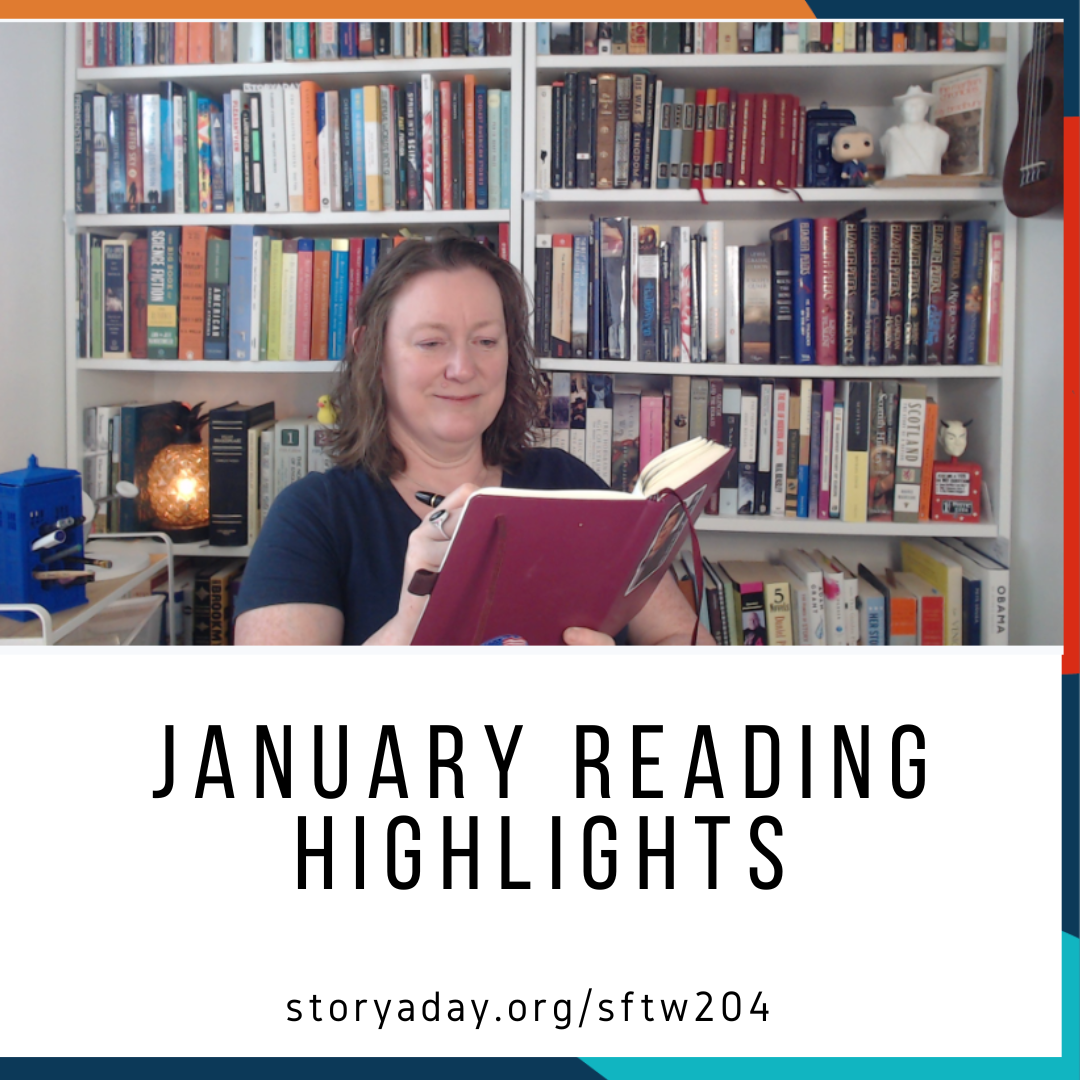
Recommended Short Stories from my Reading List – Jan 2026

One of my projects this year is to reconnect with the current state of the short story. 

Because I’m interested in the form, I read a lot of short stories, but I’ve been doing it in a haphazard way. 

But because another of this year’s goals is to submit more stories, I want to make sure I’m reading to what editors are buying and readers are enjoying now, not just what the professors say a short story should be.

How To Read A Lot of Short Stories

This year I’ve committed to reading A LOT of short stories and I’ve found a rhythm that I’m enjoying. 

Mostly that means starting or ending my day with a short story or piece of flash fiction from one of the many collections on my shelves or one of the many online publications I otherwise forget to visit.

But I’m also going to strongly recommend another tack I’m taking: every time I pick up my phone to doomscroll, I either put it down and pick up a short story collection, or swerve the social media and news sites (and yes, I deleted the social media apps from my phone, which means I have to go to the browser if I really want to get my fix) and pull up an ebook collection or an online journal.

How Much Time To Allocate

Flash fiction takes almost no time to read – I’ll read one while waiting for the coffee machine to run or the kettle to boil for a nice cup of Lavendar Mint Tea

Short stories might take ten or twenty minutes to read – perfect for getting away from my desk, drinking the aforementioned coffee or herbal tea.

Sometimes I hate the stories. Mostly I don’t.

The trick, I’ve discovered, is knowing what you like.

Finding Stories You Like

The trick to that, sadly, is ploughing through a bunch of stories you don’t like. 

Trial and error will teach you which editors, collections and journals tend to have stories you enjoy, and which have stories that frustrate you or leave you feeling bad.

Don’t love stories about trauma? It doesn’t mean you can’t appreciate good writing. It just means you don’t care to spend your break time being brought down.

Tips for finding anthologies you’ll love:

Follow authors you like on social media and when you inevitably break your self-imposed social media fast, look them up and find out what they’re recommending.

If an author whose writing you enjoy guest-edits an anthology, there’ a good chance you’ll like the stories they chose (this happened to me the year Anthony Doerr edited the Best American Short Story Collection, but it can also happen in reverse. I picked up a copy of the same collection from the year when Stephen King edited and was delighted to discover that he–an author I had never read, and had many preconceptions about–had excellent taste in fiction, which led me to reading and enjoying some of his writing too!)

Ask writing and reading buddies what they’ve read that they’ve enjoyed, lately.

Stories I Have Enjoyed from my January Reading List

‘Foreword’ by Jacqueline Freimor, Best American Mystery and Suspense 2023 

Styled as a foreword to a newly-discovered novel by a lesser-known writer, and salted throughout with footnotes, this story was an absolute delight. (Things you should know: I love a footnote and I’m a sucker for stories that use weird formats like this and stories where the story that is really being told is not the story the narrator thinks they are telling). This was a sly and delightful story, with a hint of crime a crime to earn it a place in the ‘mystery and suspense’ collection, but the real mystery is the one the reader solves by reading between the lines.

‘The Song of a Non-Human Intelligence’, Mical Garcia, Strange Horizons

This short piece is a fantastic example of interesting science fiction, told from a non-human but accessible perspective. It taps into the current AI-everything zeitgeist but does it in an unexpected way. It’s also a great example of something I’m trying to learn about: science fiction that is not focused in colonialist and extractive norms (conquering planets, mining the universe for resources). In this story an AI is embedded in a whale embryo by human researchers who, it turns out, lack the scope to understand the whole whale experience. So the AI makes a plan….it was a lovely story, and a great advert for the importance of writers coming from more walks of life than the ‘I like writing, let me do an MFA and become a teacher’ route. (Nothing wrong with that, but give me a story by a biologist or an accountant or a land management specialist, from time to time, too!

Weight Room, Paul Crenshaw, Best Microfictions 2020

This was a great example of how very short fiction differs from the 4-6,000 word short stories you might be more familiar with. 

It is impressionistic and immerses you in a moment and an environment…and then uses the ending to show you another layer to the story.

Elegantly done.

Ripen, Ashley-Ruth M. Bernier, Best American Mystery and Suspense 2023

This was a lush, lovely story with a light mystery element, that opens this collection and changed my whole expectation of what mystery/crime short fiction could be. In this story a food journalist returns to her parents’ home on St. Thomas to deal with some family and personal issues, and becomes tangentially involved in an island drama.

Take Me To Kirkland, Sarah Anderson, Best American Short Stories 2025

A coming of age story about a girl growing up–and apart from–her former best friend. It’s charming and terrifying and about something, but not self-pitying. The voice has that true teen self-absorption that comes from trying to figure out who you are. And the ending lands.

The Wif-Fi Womb, Avi Burton, Analog Nov/Dec 2025

This is a low-key, well told story about convenience and the dark side of our always-connected, always-monitoring societal trend. This one felt like it could be come (a terrifying) reality, next week.

Dominion, Lauren Acampora, Best American Short Stories 2025

This story captured the pampered ‘failing up’ nature of a former CEO in retirement, and the wife who hitched her wagon to his star and is now trapped with this one-dimensional fool, who threatens to wreck everything she’s built (he’s already alienated their daughter). In retirement Roy has decided to create a zoo of wild (and sometimes rescued) animals, and sees his hobby as somehow divinely ordained, and a benefit to humanity (of course he does). He invites his granddaughter’s kindergarten class to visit and, shockingly,  in a zoo run by amateurs, disaster strikes. Roy’s response is as inept as you would expect. This was a vicious skewering, and I liked it 🙂

‘The Billionaires Are Having A Party’, Sage Tyrtle, Fractured Lit

This is flash fiction at its best. The billionaires of the title are deliciously awful, the story doesn’t preach, but it does illuminate, and the ending packs a wallop!

Sources for these and other stories I read this month

Best American Short Stories 2025 (Celeste Ng, Ed)

Best American Science Fiction and Fantasy 2025 (Nnedi Okorafor, ed)

Analog Science Fiction & Fact

Clarkesworld Magazine

Best American Mystery and Suspense 2023 (Lisa Unger, Ed)

Best Microfiction 2023

Fractured Lit

100 Foot Crow

Selected Shorts

Flash Fiction Online

The Rumpus

Strange Horizons

All The Stories I Read (So Far) This Month

(No, I’m not reviewing them all…)

“Halfway Alive Halfway Living”, by Colton Kekoa Neves, Apex

“Look at the Moon,” by Dominique Dickey (Best American Science Fiction and Fantasy 2025).

“The Forgetting Room,” by Kathryn H. Ross (Best American Science Fiction and Fantasy 2025).

“An Ode to the Minor Arcana in a Triplet Flow,” by Xavier Garcia (Best American Science Fiction and Fantasy 2025).

“The Weight of Your Own Ashes,” by Carlie St. George (Best American Science Fiction and Fantasy 2025).

“Bots All The Way Down,” by Effie Seiberg (Lightspeed Magazine; Lightspeed Magazine).

“Nine-one-one,” by Sarah Freligh (Welkin Stories; MattKendrick.co.uk).

“Pattern,” by David Anson Lee (Welkin Stories; MattKendrick.co.uk).

“John,” by Petra Marteleur (Welkin Stories; MattKendrick.co.uk).

“A Unique Case,” by Alasdair Gray (Every Short Story, Alasdair Gray).

“Flip Lady,” by Ladee Hubbard (Best American Mystery & Suspense 2023).

“Chalice,” by James L. Cambias (Analog, Nov/Dec 2025).

“Academic Neutrality,” by M. R. Robinson (Lightspeed Magazine).

“Earth’s Last Library,” by James Van Pelt (Analog, Nov/Dec 2025).

“Jumper Down,” by Don Shea (Flash Fiction Forward).

“Stories,” by John Edgar Wideman (Flash Fiction Forward).

“Eros, Philia, Agape,” by Rachel Swirsky (The Best Science Fiction and Fantasy 2010).

“Truth and Bone,” by Pat Cadigan (Best Science Fiction and Fantasy of the Year, Vol. 4, Jonathan Strahan (ed.), 2010).

“Stairs for Mermaids,” by Mm Shrieir (Flash Fiction Online).

“Home Is The Hunter,” by James A. Hearn (BAMS 2023).

“Foreword,” by Jacqueline Freimor (Best American Mystery and Suspense 2023 ).

“The Mayor of Dukes City,” by S. A. Cosby (Best American Mystery and Suspense 2023 ).

“The Song of a Non-Human Intelligence,” by Michal Garcia (Strange Horizons;).

“New York Blues Redux,” by William Boyle (Best American Mystery and Suspense 2023 ).

“Weight Room,” by Paul Crenshaw (Best Microfictions 2020).

“New York Blues Redux,” by William Boyle (Best American Mystery and Suspense 2023 ).

“Linger Just A Little Longer,” by V. Astor Solomon (100 Foot Crow).

“The Horses Are Ready and They Need to Go,” by Christopher Citro (Best Microfictions 2020).

“Ripen,” by Ashley-Ruth M. Bernier (Best American Mystery and Suspense 2023 ).

“The Billionaires are Having A Party,” by Sage Tyrtle (Fractured Lit).

“Currents,” by Hannah Bottomy Voskuil (Jerry W. Brown’s site).

“Take Me To Kirkland,” by Sarah Anderson (BASS 2025).

“Dominion,” by Lauren Acampora (Best American Short Stories).

“One Tick,” by Joel Wright (100 Foot Crow).

“The Red Zone,” by Jennifer Galvão ( The Rumpus).

“The Wi-Fi Womb,” by Avi Burton (Analog, Nov/Dec 2025).

“The Grand AM,” by Tyler Barton (Best Microfictions 2020).

“Persephone Rides at the End of Days,” by Carmen Maria Machado (Selected Shorts 2026-01-05).

“Space Is Deep,” by Seth Chambers (Clarkesworld 232).

“The Desolate Order of the Head in the Water,” by A. W. Prihandita (Clarkesworld 232).

“Down We Go Gently,” by M. L. Clark (Clarkesworld 232).

“What to buy your husband of thirty-seven years for his birthday,” by Jay Mackenzie (Flash Fiction Online).

“The stars you can’t see by looking directly,” by Samantha Murray (Clarkesworld 232).

Polish & Submit Sprint

Showing your writing to people is nerve-wracking. It’s easy to put it off and find yourself saying:

  • I don’t know where to find good feedback
  • I don’t have anything ready
  • Maybe next time

If that has been you, now’s your moment.

I have 9 open spaces in the upcoming Critique Week, where you can submit a story of up to 7000 words and get constructive feedback from me and three other writers.

And to help you get a piece ready to show people, I’m running a brand-new challenge: a two-week Polish & Submit sprint, during which I’ll guide you through the process of revising your piece, AND invite you to co-working sessions so you have time on your calendar to actually do the work.

Registration is open now.

We start on Friday.

POLISH & SUBMIT SPRINT: what it includes

Over two weeks, we’ll take one story from “I can’t” to “I’m ready”:

  • Kickoff meeting (pick your story & make a plan you can stick to)
  • Sprint Kit (checklists, templates, and a plan so you’re never wondering “what do I do next?”)
  • 2x weekly coworking sessions (show up, write/revise together, leave with progress, with timezone-friendly options)
  • Mid-point clinic & hotseats (4–6 writers get direct help while everyone learns)
  • Final “Hit the Button” Party (submission day = celebration day)
  • Full participation in the Feb 2026 StoryADay Critique Week

Who this is for

This is for you if…

  • you’ve got a draft that’s almost a story and you keep circling it like a suspicious cat
  • you can write, but finishing and polishing is the step that makes you feel stabby
  • you want accountability that feels kind, but not fluffy
  • you want to feel that delicious, rare sensation of actually completing something

Who this is not for

If you truly don’t have even a couple of pockets of time over the next two weeks, skip it with my blessing. I may do this again.

(And if you do have pockets of time but you keep giving them to everyone else… I see you. I’ve been you. And this is why we’re doing the Sprint.)

You don’t need more inspiration.
You need a little structure, a little momentum… and a group of witnesses who will help you keep showing up.

Registration is open now

Keep writing,

Julie

Improve Your Writing The Steady, Boring Way

I don’t care what they say: January is a wonderful time of year, here in southeast of Pennsylvania.

As I type, I’m  looking out on falling snow which is muffling the world, and giving me the perfect excuse to cancel the appointment I had today and instead stay inside and read. 

The hustle-and-bustle of the end-of-year holiday season is over. The year has that ‘new car smell’. And even if you fell into the trap of making resolutions (and breaking them), we have this still, quiet month with nothing much on the calendar, not much to do in the garden, and a couple of months until our bosses start bothering us about quarterly goals.

There’s still time to make some considered choices about the year ahead. And for us, that includes what we’re going to do to improve our writing, our writing practice, and our satisfaction with both.

The End Is Nigh (Not Terribly Nigh, but still…)

Whether you made resolutions and goals or not, there’s no escaping that end of year ‘review’ that kicks in, in November or December.

What if you started planning for that now?

What if you took a moment, here at the beginning of the year to clarify what improvements you’d like to make this year: to your writing practice, your mindset, your systems, your output?

Slow & Steady

When experts talk about improving systems and outcomes, they tend to talk about 1-2%, maybe 5% improvements as achievable goals.

  • Go to a nutritionist when you’re overweight and they’ll tell you losing 5% of your current body weight will result in marked health improvements – even though that number is usually an unexciting number.
  • Business analysts recommend aiming for 3-5% growth, unless you’re ready up upend your whole way of doing business to shoot for a 10-20% increase.

When you set goals to improve your writing practice or output, remember these figures. They’re not sexy, but they are achievable and sustainable.

  • If you wrote and polished 6 short stories last year (and if you did, good for you! Me too!) why did you set your goal at 12 this year? Can you really make the wholesale changes to your routine that would result in doubling your output? Would that be fun? Or worth it? Or did you get caught up in end-of-year optimism about Future You’s ability to bend space and time?
  • If you wrote ⅔ of  a draft of a new novel last year, why are you planning to finish it, revise it and draft a new one this year? Did you forget that you also changed jobs and joined a monthly board game group, and would like to stay married to your current spouse, who’s probably going to want to see you occasionally this year?
  • If you want to go from being a writer who writes when you feel inspired, to the kind of writer who’s winning prizes, how are you going to track and measure those improvements? (Trust me, it’s hard to know when your actual writing is improving without lots of feedback. Oh, and do consider joining our February Critique Week, if quality feedback is something you’re interested in!)

Me? I’m easing into the year by reading a lot, to rekindle my love of story…and it’s working. Again

Next week I’ll tell you about some of my favorite short story reads from the past month.

Meanwhile, let me know how you’re planning to build on your past writing experiences, to make it more sustainable, consistent and/or fun, this year.

Take Your Time with Flash Fiction

Writing short fiction doesn’t have to be frantic…

Last week I talked about giving yourself the opportunity to slow down, make mistakes, and write just because you enjoy it.

This week I’m going to encourage you to put that into practice by writing some flash or micro fiction.

I know, it seems counterintuitive. Surely short fiction will be faster than novel writing. 

Ha!

Haven’t you heard the often-quoted saw, “I would have written you a shorter letter but I didn’t have the time”?

There is an art to brevity.

There is craft in knowing what to cut.

This week’s challenge

Give yourself the gift of working on a single story, told in 100, 500, or 1000 words, this week. 

  • Take the time to find a character you’re intrigued by.
  • Spend time finding an issue that you can get passionate about.
  • Wallow in the possibilities of how you can bring this character to that moment.
  • Meander through the opportunities for change, that exist for your character.
  • Write the vivid moment.
  • Stare at your prose and find ways to sculpt it so that it is spare where it can be and lush where it needs to be.

Come back to your story every day this week and ask yourself 

  • “is this the right opening line?
  • “Would they say it exactly like this?”
  • “Is that the most powerful visual I could use?”
  • “Does this last line hook the reader’s brain so they are thinking about my story for the rest of their week?”

Give yourself the gift of time and space to craft an exquisite morsel. 

Even if you are the only person who ever enjoys it, aren’t you worth the effort?