I got another great question from the StoryADay community this week and I thought you might be interested in eavesdropping on my answer.
But first, in Notes from Julie’s Desk, I’m going to confess that my own ambitions for One-Story September were derailed by sickness.
Now that I’m on the mend, however, I can definitively assure you that—even if you start late—the One-Story method is paced to make sure you can still succeed. (Here on Day 5 I’m still fleshing out my story idea, but it’s proving extremely motivating to know I still have 25 days to work on this story, and a guided process to keep me on track. Want to join us? You can still do that, here.)
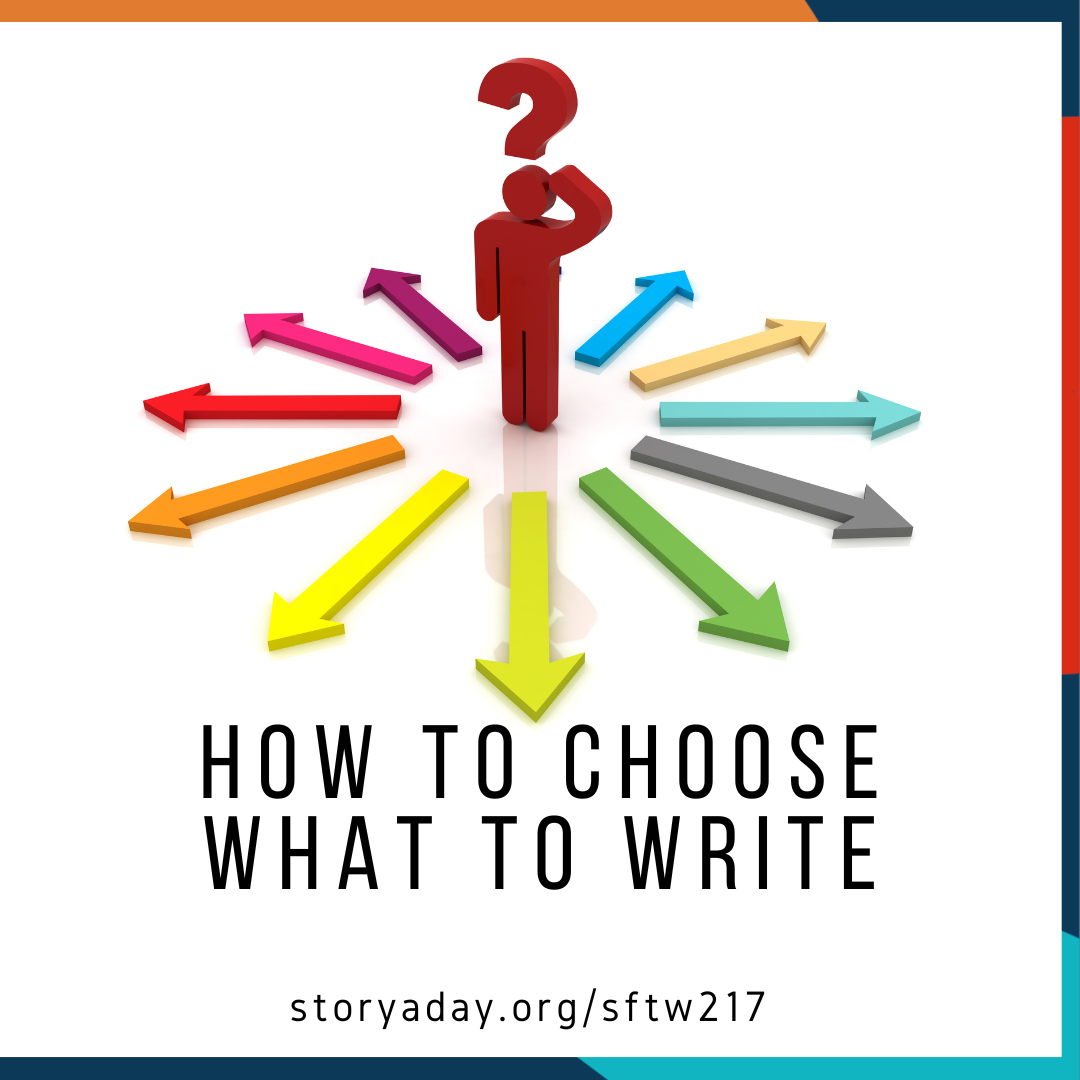
How To Choose What To Write
The question, paraphrased, was,
“I have so many ideas. How am I supposed to pick which one to work on? Or should I maybe try to incorporate them all into one piece? I don’t know…and then I get paralyzed.”
Sound familiar?
My answer went something like this.
Firstly, good for you for diagnosing the problem—that’s Step 1 in finding a solution.
Secondly, this probably is much more common than you probably think.
I firmly believe it’s one of the reasons a lot of writers get more done during challenges like StoryADay and when they have an upcoming deadline for a writing contest or themed anthology: the lack of choice is freeing.
OK, but without an external voice forcing your hand, how DO you choose?
The first thing to understand is that any choice you make is only a choice for now.
That’s certainly easier to live with (especially during something like One-Story September) than the idea that you have to make the right choice, for all time.
Choose.
Experiment.
Examine what happened (and how you felt about it), and then
Make another choice and run another experiment.
Does that really work?
“Creativity is not some privileged kind of thought free from constraint. Rather, it is normal problem-solving, just directed at a specific and interesting problem.” – Herbert A. Simon, quoted in Inside The Box by David Epstein.
This is both key and incredibly encouraging. Talent is not required. Genius is not required. A world-changing inspirational idea is not required. Just a problem that interests you, and your willingness to keep noodling on it.
There is no ‘right’ answer to ‘what should I write?’. Ever.
There are only these questions:
- What specific idea do I find interesting, right now?
- Can give it to a character and have it cause problems for them?
- Can I sustain my interest in solving each subsequent wrinkle created as my character begins to tackle the main problem…until I reach the end?
Bonus tip: you won’t know if the answer is ‘yes’ until you get out of the abstract thinking phase and into the concrete ‘ideas on paper’ stage.
A short story—even a novel—has an end. The process of writing it has an end.. Any story you start should not become a life-long project.
You are experimenting. You are problem-solving.
So just pick something, and throw problems at your characters until they are smart enough to solve them (potentially happy ending), or have demonstrated that they can’t (potentially bleak ending).
Final caveat: the lure of the new idea is strong, especially when the problem-solving in your current project gets hard. Resist the urge to believe that you’re missing out on a ‘better’ idea, or a better story and abandon the one you’re working on. There’s nothing wrong with switching between projects if that makes your brain happy, but don’t believe the lie that there is a perfect idea, a perfect story out there waiting for you. Just keep solving problems.
Keep writing,
P. S. I’m serious: if you want to be writing and could use a framework to get you through this month, consider jumping in—fashionably late—to the One-Story Challenge.
How do you choose what to write? Does your method differ? Leave a comment here, and let me know.