Write1Sub1 – A New Short Story Writing Challenge for 2011

This week I’m bringing you news of a great new short story writing challenge from StoryADay member, Simon Kewin.

Next year Simon and his friends Milo James Fowler and Stephen V. Ramey have pledged to Write1Sub1 – that’s Write One Story and Submit One Story every week of the year (actually, Simon’s taking Christmas off, but still…). You can submit to magazines, websites, or short story contests – anywhere that takes writing seriously.

And they’re not keeping this challenge to themselves: they’re inviting everyone to kick their writing career up a notch by joining in. At the end of this year of intensive writing, you certainly should have figured out how to write a short story, don’t you think?

Here’s an interview with Simon to tell you more. Links to more short story writer’s information are at the end.

What were your inspiration and your personal motivation for this challenge?

Ray Bradbury was our original inspiration. He is supposed to have completed and submitted a short story every week for a year while establishing himself.

The idea for Write1Sub1 materialised during a comment discussion on Milo’s blog and it took off from there. The point is obviously to help our own writing : to provide a focus and an incentive, a sense of community. We’re all keen short story writers and this seemed like a great way to motivate us to write more.

What are the ‘rules’?

The idea is to write a story and submit a story every week for 2011. It doesn’t have to be the same story as obviously it can take more than a week to polish a piece! Those taking part can define “story” as they like : it could be as short as a flash or nano piece for example. It could even be a poem. Whatever works for you.

Some people like the idea but have decided to Write1Sub1 on a monthly rather than a weekly basis, which is fine. Hopefully the challenge will still be a help to them.

How do people join in?

There’s the Write1Sub1 blog to follow and there’s also a Linky there to “sign up”. We plan to do a weekly check in post on a Sunday for everyone to share their experiences of the week. We’ll do a monthly one too for those doing it that way. There is also a Twitter hashtag people can follow #Write1Sub1 and there are banners on the blog folks can download.

Where will you submit?

Good question! The people who’ve signed up write a wide variety of different things, so I suppose we’ll all have our own target markets. But we’re putting together a page of useful resources on the blog for tracking down markets, and obviously, sharing our experiences on the blog should be a great help.

How will you stay motivated (esp when the inevitable rejections come in) ?

Hopefully being part of the Write1Sub1 community will be a big help here. It’s definitely a help to know others are going through the same experiences! And of course, the thought of receiving the end-of-year “winner” banner will be a huge incentive!


Thanks, Simon!

There are so many articles in the world already about ‘how to write a short story’,  but I’m a firm member of the ‘learn to write by writing’ school or thought. (And reading, of course!). This is one project I’m not going to be able to resist, although I’ll be signing up for the monthly version (there are banners for that too, at theWrite1Sub1 site).

It should ensure that I don’t get lazy and forget how to write a short story between now and May, when StoryADay starts up again!

Useful Links and Writers’ Markets

Write1Sub1 Rules

About the guys behind Write1Sub1

Market Listings from Write1Sub1

2010 Novel & Short Story Writer’s Market from Writer’s Digest (aff)

Writer’s Market listings from Writer’s Digest (subscription required. Free email newsletter)

Writers Weekly Market Listings (mostly non-fiction, but occasional fiction listings)

Becoming A “Real” Writer – Interview With Heather Muir

Heather MuirAnother inspiring interview, this time with Heather Muir, a StoryADay alumnus who made it to 31 stories and then went off to Writer’s Camp and is working on her YA novel now.
Heather says she used StoryADay to help her “make the transition from student writer to ‘Real’ writer”. Yay!

Before you started StoryADay how would you have described your writing life?

Very sporadic. Just before StoryADay started, I had graduated with a B.A. in English with a creative writing emphasis. I only wrote for deadlines in class and I occasionally wrote something on my pet project, a fantasy novel I started when I was 16 that has been reincarnated so many times I don’t know what it is anymore. I needed a challenge.

What made you decide to do StoryADay?

A few weeks before StoryADay started, I had been accepted into Orson Scott Card’s Literary Bootcamp that would start at the end of June. I knew I needed to pump up my writing muscles as much as I could before the camp and StoryADay seemed like the answer.

What did you expect to achieve? What did you actually achieve? What did you learn during the challenge?

By the time I had heard about StoryADay, May was only two days away. My goal was to write a story every day as well as come up with the story idea every day. I wanted to test my ability to come up with stories quickly and from anything and everything.

I did write a story every day. I wrote a total of 10,987 words. On a few days my stories were only a few sentences long. Some I look back on and say “What was I thinking?” Only a handful of the stories are worth keeping and working on. One of them has spawned into an idea for a middlegrade book that I am in love with. Another is going to be incorporated into the motivations of the evil queen in a retelling of a fairy tale I want to work on.

What I learned from the challenge was that I could write everyday. It was hard certainly. But it really helped me make the transition from student writer to “real” writer. I no longer had school to fall back on, giving me deadlines. StoryADay was a great way to get that deadline and prove to myself that I was a serious writer.

How do you make time for writing?

Making time for writing is easy when you don’t have a social life and you are a bit of an insomniac. 🙂 I work at a 24-hour pharmacy so I never have a consistent time to write. Usually I try to write in the time before or after work. It’s never more than an hour or two but it is enough to stay consistent.

Why do you write? What keeps you motivated?

I write because I love stories. I was the kid who loved read-a-thons and going to the library. I write because I have to. I have tried to stop. I tried to start pharmacy school, to upgrade from technician to pharmacist but I could not get the story ideas out of my head. They haunt me until I write them down. And I also learned I could never be a pharmacist because I would hate my job. I don’t even want to hate my job. I want to live the dream and create for a living.

As far as motivation, I keep in contact with other writers. I have a writing group. I attend local conferences. I listen to a great podcast, Writing Excuses. I read a lot of books and remember how much those stories mean to me, how they have changed who I am. Now it’s almost unthinkable to not write.

The desire to create is too strong to ignore.

What’s Next?

As I said, I attended OSC’s Literary Bootcamp and returned triumphant. I’m now working on a YA novel about ghosts that I started at the camp. I hope to have a full draft finished in the next 6-8 months (judging by my pace so far). I have two other novel ideas on the back burner (one of them that came from story a day) as my next projects when the current novel is being submitted.

I hope StoryADay continues to be a success. It was very helpful to me though I don’t think I’ll participate again, now that I’m working on larger projects. It is perfect for the writer who lacks the courage to write and needs that support. StoryADay helped me. I hope it helps others.

Thanks Heather!

[And one more thing: I’d love to interview you about your writing, no matter what stage you’re at or whether or not you’ve done one of these creative challenges, so leave me a comment below if you’d be willing to chat.]

Story A Day May 2010 In Review

Sick of starting and never finishing writing projects, in April 2010 I announced that I was challenging myself to write a story a day in May.

“Write a story a day. Finish them.” Those were the only rules.

Born of A Hunger To Write

Word spread around the writing blogs and the Twitter hash tag #storyaday was born. Within 3 days about 80 people had signed up to join in, and many more joined throughout the month. At last count (not counting spam bots) the active membership was in the hundreds.

Some people decided to write on weekdays only, some declared they would sketch a story idea every day, some weren’t sure what they could manage anything, but just the idea of committing to this hare-brained scheme with a bunch of other writers had got them so excited they couldn’t resist.

The enthusiasm for the project amazed me. It spoke of a hunger to write, no, a hunger for permission to write that I never dreamed was so widespread.

We gathered our story ideas and fragments and waited for the “off”.

Who Were The Writers?

The writers came from all walks of life and all over the world:

  • The youngest participant was a seven-year old home-schooled girl from Texas.
  • One of our writers from nearer the other end of life’s journey lives in New Zealand. Every day she had written and posted her story long before the US participants woke up.
  • We had participants from the US, Canada, Singapore, the UK, New Zealand and Australia.

What Did They Achieve?

While several of the writers did write 31 stories in as many days, many others declared victory on their own terms.

Some were simply thrilled to be writing actual stories again after years of putting it off.

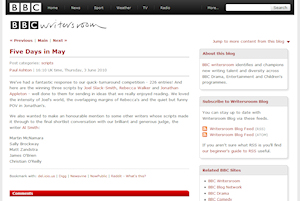
BBC  Writers' Room Screenshot
Honourable Mention from the BBC

Some were active novelists who found that writing stories every day jumpstarted their creativity and allowed them to try new voices and approaches, freshening up their prose.

Some have already had external success with their Story A Day stories: Matt Zandstra’s Story A Day idea turned into a radio play that was chosen as a runner-up in a contest at the BBC’s Writer’s Room — judged by a working BBC drama writer.

Me? I got to write (almost) every day, finish most of the stories and, in the process remember how to make a short story hang together.

But most of all, I got a huge creative boost from writing, reading and sharing stories with a bunch of other writers who understand the urge to write in a way that ‘normals’ in our lives, no matter how loving, really can. I found friends. I found my tribe.

What’s Next?

Please come back to the site between June 11-14, when we’ll be highlighting some of the best stories to come out of this, the first StoryFest.

Then, sign up for the mailing list, so we can send you details about next year’s challenge.

Whether as a writer or a reader, we’d love to have you as part of the family.

Lessons Learned After Writing A Story A Day

When I said I was going to write a Story A Day in May, plenty of people looked at me with *that look* in their eyes, or said thinks like,
‘Well, good luck…” [1. I expect if you’ve ever taken on any kind of creative assignment (not directly related to a paycheck) you know what I mean by *that look*.]

“Why?” was the most common question. Good question. If we’re not writing for money, then why do we write?

“How ?” was the second most common question.

I wasn’t 100% sure about the answer to either. After a month of attempting to write a story a day I do have some answers.

How To Be A Prolific Writer – Even When You Don’t Have Time

I’m not going to lie and say it was easy to find time for writing this month. In fact, I almost never ‘found’ time. I ‘made’ time.

Making time means something else had to give. Sometimes it was housework, but more often it was the relatively random consuming of information that I do. The BBC news website might have been minus a few thousand hits this month, my personal blog was updated less. The grocery shopping got more, er, targeted.

But the biggest lesson I learned about the “How” was this:

How To Write Anything

  1. Start writing.
  2. Write until it is finished.

It is one of those annoying pieces of advice that mean almost nothing until you try it.

Sitting down to write can be paralyzing. It is so much easier to get up and walk away—tell yourself you don’t have time—than it is to start writing.

I had to, so I used story prompts, memories, jokes, other people’s stories, to get me started. I put my pen on the page (quite literally) and told myself to write a sentence. Anything. One day I started by simply describing where I was sitting. It turned into a story about a homicide detective!

So, the answer to ‘how to write’ becomes quite simply:

Commit to doing it. Make time. Start writing.

(I did learn a bunch of other trick for helping with that, which I’ll be writing about soon.)

Why Write?

Once I had started figuring out the ‘how’ I was amazed to discover an amazing set of benefits in the ‘why’ column – some that I had not expected.

I found that, if I sat down and got a story started in the morning,

  • It energized me. I was more (not less) likely to take care of the laundry, the dishes, the 1001 other mundane things that we usually blame for getting in the way of our writing.
  • I became more responsible and attentive to all my obligations, from family to my business.
  • My brain was less fuzzy. I spent less time worrying about all the things I ought to be doing, and, instead, started crossing things off the list, prioritizing better than ever, in order to get back to my writing (to make time for it).
  • I paid attention to the world around me. I was doing that thing people talk about as ‘living mindfully’. I was doing it in order to gather ideas and snippets for stories, but no matter why you do it, mindfulness is acknowledged by religions, psychologists and hippies, to be A Good Thing.
  • I found I had more time to give to people, because I wasn’t constantly feeling like I ought to be doing something, or resenting the time they were taking from things I really wanted to do. I had made time for myself and my thing, and now I could take an interest in you and yours.
  • I even wrote my way out of a really foul temper one day, just by letting my characters do and say things I never would, in real life, being all well-brung up and all that.

So the sort answer to ‘why do you write?’ is just this:

It makes me a better, happier person.

As an added bonus, posting some of my stories, made some readers happy. Granted, a lot of them were related to me, but some were complete strangers.


If you have ever thought about doing one of those creative challenges like NaNoWriMo, or The Artist’s Way or any other challenge, I highly encourage you to commit to doing it. What you gain will be so much more than you sacrifice. What you learn will be so much different from what you expect.

Meanwhile, why not subscribe to the StoryADay.org mailing list, so that you’ll be among the first to know when we’re gearing up to do this all again next May? I’ll send you a copy of my Short Story Framework, to keep you going.

Story A Day Festival

We have all worked so hard, don’t you think it’s fair that we get to show off a little; celebrate?

Announcing:

The Story A Day Story Fest, June 11-14, 2010: An Online Celebration of the First Annual Story A Day Challenge

What Is It?

From June 11-13 the front page of this site will change to the StoryFest Page.

The StoryFest page will contain blurbs about and links to each author’s favorite story (or collection of stories if you’re writing super-short stories)

Readers can come by on their coffee breaks, browse the best of our work, leave comments, tell their friends.

What Do You Do?

  • First, sign up for the mailing list so that I can contact you.
  • Next, pick your favorite of your Story A Day stories  that you wrote. If you need to, spend a few days polishing them up. Pick one, if it’s a long or multi-part story. Pick a couple if they are short. Pick ten if you’re Simon 😉
  • Write a short blurb about you/your stories/the challenge (about 50-75 words).
  • Optional extra: pick your favorite one or two stories by other people to recommend to readers.
  • Send me the blurb (@admin) and the links to your stories and your ‘recommended reading’ stories by June 9. I will put them on the StoryFest page for readers to find.
  • On June 10, start tweeting and blogging and Facebooking (sorry) and telling all your friends and family to stop by. (I will provide some sample messages, in case you’re uncomfortable with self-promotion, but you should feel free to write whatever you like.
  • During StoryFest be sure to share your recommendations for stories you’ve enjoyed by other StADa writers.
  • On June 14, send another reminder to people that time is running out, to access the StoryFest page, and discover all the wonderful new writers that you’ve been reading and enjoying throughout May.
  • Sit back and bask in the feedback.

I’m planning on creating a StoryADay StoryFest graphic that you can hang on your StoryFest stories, no matter where you posted them (here or your personal blog)

What Can Readers Do?

Readers can stop by any time between June 11 and June 14.

They will find the front page all decked out for StoryFest and featuring links to your favorite stories.

They can read, comment and, I hope, recommend stories to their reading friends.

What’s The Point?

It’s a celebration! Writing a story a day was hard, wasn’t it?

This is our chance to show off. This is our recital. (Tutus strictly optional).

It’s also a chance for readers and writers to connect. Readers are always looking to find great new writers and interesting stories. Writers want to be found.

I’ve been thrilled by the quality and diversity of the stories I’ve read here, and I want to share that with other readers.

Why So Short?

Making the StoryFest an event with a limited timeline gives readers a good reason to come NOW, not just think ‘that’s cool, I’ll stop by later maybe’ and then forget about us. Instead, we’re creating scarcity and a deadline. It’s basic sales psychology, and it works!

None of the Story A Day blogs will disappear (unless you delete them), so readers can still find your stuff for as long as you want them to.

The StoryFest is just a big promotional/celebratory party, and we all know that at some point, every party has to wrap up and someone has to turn out the lights.

Luckily there won’t be any dishes to wash after this one.


So remember, please SIGN UP FOR THE MAILING LIST so that I can contact you with more details about StoryFest and, after that, the plans for the Second Annual Story A Day May!

It’s Almost Over. What Now?

Hey everyone,

We’re drawing to the end, and I know everyone is racing to complete their stories and write their “What I Learned During Story A Day May” (I kid), but I wanted to get your thoughts on what come next.

I have some thoughts (not least of which is getting you all to sign up to a mailing list so I can email you in April next year and do this all over again), but I’d really love to hear what you would like to happen next.

Thanks a million for making my hare-brained scheme such a success and soooo much fun. I couldn’t have done it alone!
Julie