At this point, it’s almost impossible you haven’t encountered a piece of software that tried to convince you to use it’s new AI features.
Today you’re going to write a story that delves into the relationship between humans and technological pals…and this stuff is going to seem a lot less sci-fi than it used to!
Bonus points if you write this story in a non-narrative format. That means,
Writing out a chat conversation, or making a list of things that your character needs to complete their project (and telling a story in the process).
Or perhaps your character is trying to write a ‘rescue me’ note in a code that the AI won’t break.
Or perhaps you’re writing the after-action report for your corporate overlords about how things went so spectacularly wrong.
If you don’t want to write about the tech we have today, you could have a medieval knight working with a clockwork squire; or steampunk Sherlock Holmes android invented by Dr Watson…run wild!
Get the StoryADay Challenge Handbook for 2026 – custom warm-up and brainstorming exercises for every prompt, delivered as a private podcast with transcripts. SUBSCRIBE NOW
Julie Duffy
Julie Duffy is a writer and the host of StoryADay. She lived in an era when humans still thought they were in charge of everything, and she thanks her Robot Overlords for allowing the relic of that time to continue to exist online.
Join the discussion: what will you do with today’s prompt OR how did it go? Need support? Post here!
Remember: Please don’t post your story in the comments here (and I talk more about why not, here). Best practice: Leave us a comment about how it went, or share your favorite line from your story.
Here’s your next Game Piece. save the image and share on social media with #storyaday
It’s tempting to think that other writers have it easier, or other times were easier on writers.
Wasn’t it easier to get published when there were more independent publishing houses?
Wasn’t it easier to make a living at writing in the golden age of magazine publishing?
All those other writers who are selling their work must have some kind of cheat code that they’re not sharing with us, right?
This week I read the editorial in the February 1951 issue of Galaxy Science Fiction magazine, a relatively new publication at the time. The magazine was making its mark, in part, by offering the highest rates in the market in order to attract the best writers. And they did—publishing Brandbury, Asimov, Clarke, Del Ray, Simak, in their primes.
But here’s a snippet from the editorial that I found weirdly encouraging. Editor H. L. Gold was trying to explain to readers how the economics of the writing business work, but I think he left an important message for us writers, too:
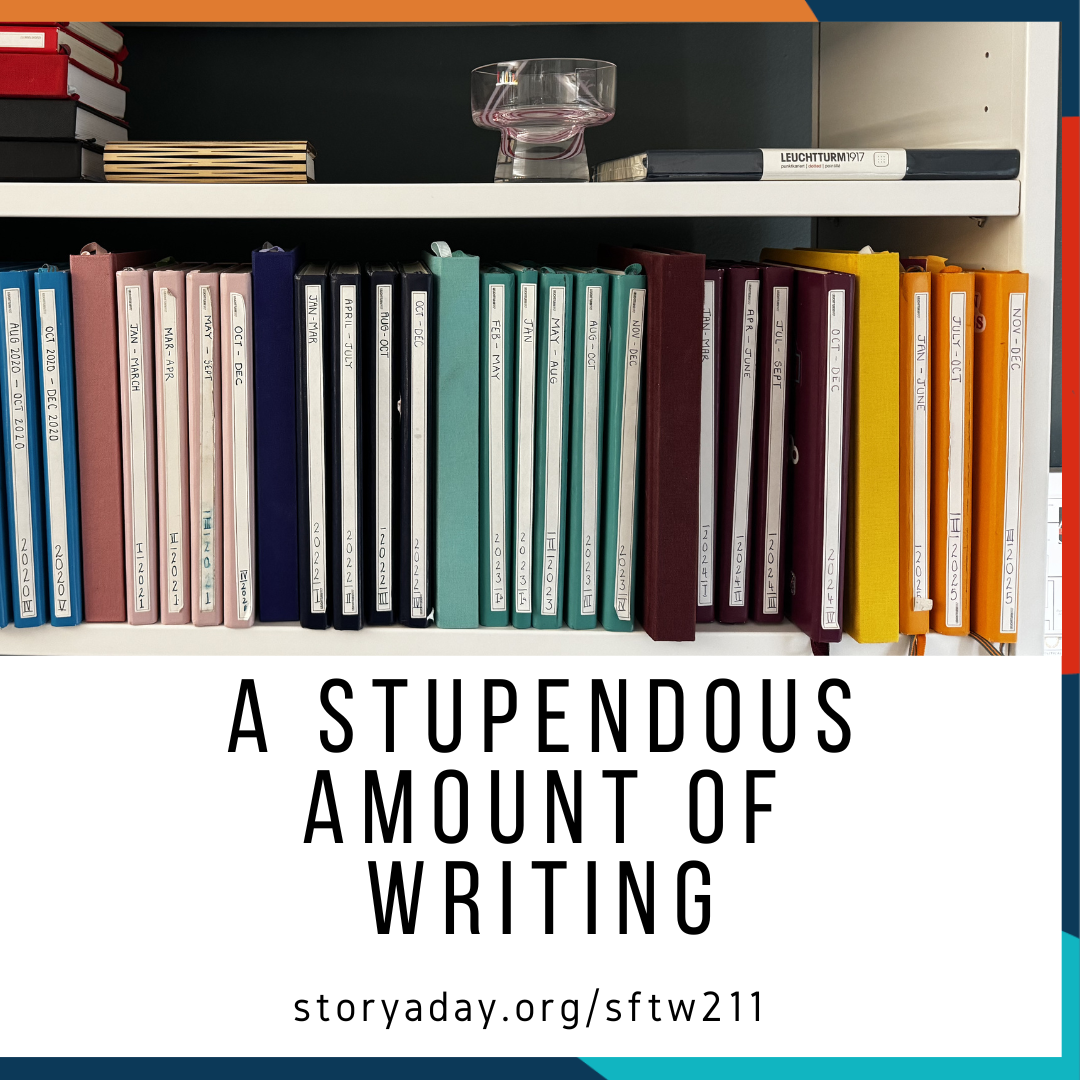
“Counting false starts, stories that won’t work out, stories that shouldn’t have been written at all but seemed good at the time, research, productive labor, etc., it takes a stupendous amount of writing even at the highest rates to support an author and his family on magazine sales alone.”
-H. L. Gold, Galaxy Science Fiction, February 1951
There’s your cheat code: there is no cheat code.
There’s just ‘a stupendous amount of writing’.
Which we love to do, anyway, right?
Looking At The Wrong Metric
When people think of success as a writer, they tend to measure external, visible rewards: sales, income, awards, praise, etc.
But the rewards, if we’re honest, hit most deeply in those moment when a story draft pivots towards it’s real purpose, when you suddenly know what the story is really about; or when you realize you’ve revised it as far as you can, and it’s ready to be read by someone else.
The real reward is in the writing.
What stalls a lot of people is the sense that you’re doing it wrong if you’re making ‘false starts, stories that won’t work out, stories that shouldn’t have been written at all but seemed good at the time…’
If you feel like you’re ‘not a real writer’ because it requires a stupendous amount of writing to generate the occasional piece that works, H. L. Gold would like a word…
He left those words in his editorial to justify paying the highest rates on the market; and they serve to remind us writers, that this was never easy. And that’s OK.
Write a stupendous amount this week
If you’re an ambitious* writer, you have to write a stupendous amount to reap the rewards you’re after. It’s not a race or a competition. You don’t have to burn out. But you do have to write. Probably more than is comfortable.
(*And ‘ambitious’ doesn’t have to mean ‘support myself financially via my writing’. That might be part of your ambition. But I suspect the true ambition is to do the best work you’re capable of.)
StoryADay May is an opportunity for you to find out what ‘a stupendous amount of writing’ feels like, over one month’s time. Are you capable of pushing through, writing when you don’t feel like it, and giving up on those ‘stories that should never have been written’?
If you want to feel the sharp satisfaction of success – whether that ‘success’ is ‘a day of good writing’ or ‘a story sold’, both are valid – remember that ‘a stupendous amount of writing’ is the baseline. It’s the thing that helps you find the stories, tell them well, and sense your own progress.
It’s OK if you don’t want to do all that work. If you have better things to do with your time, by all means do them.
But if you’re floating through life waiting for it to become easy I have some bad news: the struggle is frustrating, and annoying, and sometimes painful, but it’s also where the rewards lives.
What will you write, this week?
Here are the most recent prompts from the StoryADay challenge
Not sure how to get started with prompts? The StoryADay 2026 Handbook has custom warm-ups and brainstorming exercises designed to catapult you into your day’s writing. Get it now (NOTICE: PRICE WILL INCREASE ON JUNE 1, 2026)
Get the StoryADay Challenge Handbook for 2026 – custom warm-up and brainstorming exercises for every prompt, delivered as a private podcast with transcripts. SUBSCRIBE NOW
Get the Essential StoryADay Challenge Handbook (the one that’s a short story course disguised as a challenge) from 2024. Video, audio, written lessons & captions START HERE
There comes a time in every writing push when it feels like you’re failing.
Whatever goal you set, you’re not meeting it.
You’re imperfect. And your best intentions, it turns out, aren’t enough.
If this is you, you are not alone…and I have a fix: Instead of hoping to find time for writing, you must take concrete steps to make sure writing happens.
Startitis
We start projects (stories, a novel, a challenge) with the best of intentions.
This time, we say…This time I’ll do it perfectly. If I just work harder, I won’t have bad days.
Yeah…that’s not a thing.
When It Gets Tough
Writers aren’t machines.
We do have to keep showing up even when it doesn’t feel easy, but to do that and stay productive, you must show up with a boatload of compassion and joy.
That is easier to do a, when there are fewer decisions to make and b, when you’re around other people who get it.
Not “Will I Write?” But “When Will I Write?”
I’m as allergic to being told what to do and when to do it, as the next neurodiverse/creative person.
And yet.
Writing time doesn’t just appear because we want it to.
If you’re having trouble showing up for your writing right now (looks in the mirror. Nods.) you might need to take a look at your schedule and see if you have planned time where the writing can happen.
Without a plan, it won’t happen.
Even if you plan to write on Friday afternoon but get suddenly inspired as soon as you wake up, that’s fine. Flexibility is good.
But having a plan–even one you react against–is a powerful way to limit the number of decision you have to make in the moment, and hoard your creativity for the actual writing..
Making time for your writing a gift
… to yourself and the world.
It’s not about creating a rigid conveyor-belt-of-words you must staff at all times.
It is about making your writing a priority, before other people’s priorities steal all your time away from you.
So. I’m off to put some potential writing times on my calendar. How about you?
Inspiration Corner
Here are some prompts that you might have missed, this month, to get your creative wheels turning.
The StoryADay Challenge has rolled into its second week for 2026, and there’s a lively community of writers leaving comments about their writing, over at the blog.
Even if you’re not taking part in the challenge, why not read through them and commit to writing one story sparked by one, this week?