How To Be More Disciplined, As A Writer

In an early scene in the ‘fish out of water story’ TV show Ted Lasso, Ted—an American—is offered a cup of tea by his British host. He sips the tea and promptly spits it out…right into the face of his glamorous new boss.  

“It’s horrible,” he says, shaking his head.

Same, Ted. Same.

I have a cup of tea about once a year, just to make sure I’m not missing something. 

Nope. Still horrible.

What Does “Discipline” Taste Like, To A Writer?

When I ask writers about their biggest challenge ‘time’ is always number one, with ‘focus’ or ‘discipline’ or ‘consistency’ running a close second.

But what does ‘more focused’, ‘more disciplined’ or ‘more consistent’ look, smell, feel, and taste like?

As a Brit, ‘tea’, to me, has a narrow definition. “Tea”=black tea…and I do not like it.

But if we allow ‘tea’ the more expansive definition Americans often use, I can like ‘tea’. There are plenty of herbal infusions that give me actual pleasure.

Define The Terms

The ‘Productivity industry’ has a lot to answer for. 

It has pushed a grim vision of ‘discipline’ that says if you don’t show up every day, and suffer a bit, you’re failing. 

I bought into it.

I started the StoryADay May Challenge because I thought I needed to write every day to ‘be a writer’. I couldn’t make myself do it for more than about 12 days and I thought that accountability and the threat of public shame would fix that.

Confession time

Forgive me writers, for I have failed: I have never once created that unbroken streak of days when I started and finished a story for 31 days in a row. 

Not once in 16 years.

Does that mean I’m not disciplined enough to be a writer? 

I’ve certainly wasted enough time worrying about that, over the years. 

Maybe you have, too. 

They Laughed At Me (in the nicest possible way)

It took other people laughing at me (kindly) to make me notice that there is a certain discipline (stubbornness?) and consistency in:

  • Running an annual challenge for 16 years straight; 
  • Writing five novel drafts; 
  • Writing enough short stories—and sending them to enough markets—that some of them have been published;
  • Leading a writing community for 8 years; 
  • Producing almost 340 podcast episodes and writing almost 2,500 blog posts about this writing journey we’re all on.

I still can’t write fiction every day.

 AND I have learned so much.

 ‘Failing’ my own challenge year after year is a delightful reminder to me that ‘disciplined’, ‘consistent’, or ‘focused’ are never going to look, for me, like creating an unbroken streak of days where I write new words. (Your mileage may vary.)

I need days off. I need time to wander around and breathe in life, without the pressure of having to synthesize those experiences and breathe them out into new words, today

.For me, ‘consistency’ and ‘discipline’ will likely always be lumpy, seasonal, cyclical things. 

Sometimes it looks like generating new words. 

Sometimes it looks like learning new skills

Sometimes it looks like taking two steps backwards as I experiment 

Sometimes, yes, it looks like staring out of the window or going on a long walk.

And it all adds up.

Do This Now

If you keep telling yourself you’re ‘failing’ to be consistent or ‘disciplined’ in your writing, look back over your lifetime and notice the times when you were most productive. 

  • What was working for you, then? (And it’s more than ‘I had more time’. It’s also ‘I had something I was trying to achieve’ or ‘I had someone cheering me on’ or even ‘I was paying for a class so I showed up’)
  • Did you ever need to sit at your desk for 3-4 hours every weekday to produce quality writing? (If not, why would you think that’s what a ‘successful writing life’ looks like, now?)
  • Take a look at your upcoming week and ask ‘what’s the tiniest step I could take to show up for my writing this week?’. Then put that on a piece of paper and carry it around with you. Do it. Celebrate with a dance party in the privacy of your bedroom (I suggest listening to music you loved as a teenager). Then come back and do it again. 

Practice joy in your writing life enough, and you’ll start to crave it. 

Consistency and discipline become issues you never have to worry about, because you’re chasing something better.

LEAVE A COMMENT: What has helped you feel more successful/joyful in your writing lately? What is an essential part of your practice? What’s negotiable?

Writer's Jumpstart Call with Julie image

Why Bother Writing…

…in an age of AI?

Watch The Video Edition

I’m already starting to think about next year’s StoryADay May and, here in this age of AI, I was struck with the awful thought: why bother?

AI means you can generate 31 short story writing prompts in 90 seconds (5 minutes if you’re willing to wait for more polished prompts with a theme and multiple repetition. How do I know this? I asked it.)

It takes me roughly 3 months of (admittedly part-time) work to research guest authors, reach out to them, assemble their responses, curate and cue them up, create pretty images, summaries, and queue everything up.

But the point is that you get a human-created journey through a month of story writing. You get a peek inside the head of other writers. And you get to have the experience, along with other writers in the community.

It’s not for everyone. But I’ll keep doing it for you.

And also for me.

Because the work is not just about the prompts. It’s never just about the output, the end product.

Writing Changes Us

The struggle, the striving, the research, the craft, the failure, the resilience, the patience, the growth…It’s personal development at its finest.

How To Bother, in an age of AI

I’ve been preaching this for a decade and a half (and now I have the experience of leading a group for 8 years to back up my hypothesis). 

The most important foundation you can give your writing is to:

  1. Define success

If you don’t know what success means for you, how are you ever going to know if you’ve attained it.

Not someone else’s vision of success.

Yours.

And that means asking some questions about why you’re doing this.

  • Are you doing it to be published?
  • Are you trying to support yourself from your fiction writing?
  • Are you building a daily practice for self-development?
  • Are you trying to improve a particular craft skill?
  • Are you keeping a promise you made to yourself as a child?
  • Are you setting an example for a younger person in your life who needs to see what ‘self-respect’ looks like?

This is Step One. 

Without it, you will never be—or feel—successful, no matter what external measures of success you hit.

If you skip this step-–or if you think this remains static forever—it’s almost impossible to be productive, motivated, or fulfilled by writing. If you’re simply on a treadmill, turning out words, you’ll be consumed by the idea that it’s never enough—that you’re not enough.

Do This Now

If you haven’t taken the time to examine your definition of success lately—and perhaps to notice how it has changed since you were 14, 25, 35, 45—put down your pen, push away the keyboard, and spend the next week just noodling on these questions:

  • What does success look like for you, in the next few years?
  • In order to get there, what milestones would you have to hit, if any?
  • What would you have to do regularly, to feel successful when you look back at your month?
  • What does that look like, for today?

If you do this exercise right, you’ll notice that it becomes easier to show up for your writing and enjoy yourself.

Without taking this step, your internal ‘motivation process’ can look like this:

“Today I have to work on finishing the novel so that I can get it out into the world and quit my job and prove to [that friend/family member] that I haven’t been wasting my time all these years.” [Sighs. Drags self to coalface….]

Not only is that demotivating since your inner critic is bound to kick in and try to keep you safe by pointing out how hard it is to do what you’ve outlined. It’s also doomed to fail, as a path to success today, because it’s impossible to figure out what first step to take today

And so it’s impossible to know when you’ve finished your work for the day. Without a clear definition of what success looks like to you, you’re likely to do nothing, or to keep working until you’re so exhausted you have to stop. Neither of which makes you feel successful, or advance you towards external success. 

So you pick up your phone and doomscroll and go to bed promising to do twice as much tomorrow, still without a clear idea of what that looks like.

No More Doomscrolling

If you have done the work to figure out what ‘success’ looks like for you—for now—your internal motivational conversation goes more like one of this:

“I know I want to finish this novel, because I want to prove to myself that I can write something I’m proud of. I need to finish the scene where the protagonist confronts the bad guy, but I’m having trouble doing it. Maybe I need to back up and do some character exercises (from that course/book I bought and never finished) to figure out the characters’ real motivations. OK, that won’t add to the manuscript’s word count today, but I’ll learn more about the characters, which might free me up to write the actual scene tomorrow. So today’s task is: find that character exercise I remember liking in that course I took, and go through it slowly. When I’ve done that I’ll summarise my thoughts, for next time, then my reward will be to take a walk outside.”

(Notice the reward. That’s a key part of building a satisfying practice and feeling successful in it.)

Picture The Day

Imagine yourself at the end of a day when you’ve ground through 2,000 words or four scenes, because “that’s what successful writers do”, and then collapsed on the couch with a whisky, ‘to recover’. 

No imagine yourself at the end of a day when you took a small concrete step that aligns with your goals and your current energy, and that you can put a checkmark next to as ‘accomplished today’. You bound out of your chair with energy left over to hang with the kids or the spouse, knowing that you’ll be back in a day or two to tackle the next task.

Doesn’t that feel like a successful writing life, regardless of external rewards or judgment?

So should you bother writing, in an age of AI, even if the external rewards you once hoped for aren’t guaranteed?

I, for one, say “yes”.

Need help tracking your successes? Get the Planning & Tracking Bundle

LINKS

LINKS

StoryADay Challenge archive: https://storyaday.org/writing-prompt-archive/

SWAGr monthly accountability posts: https://storyaday.org/category/swagr

‘Define Success’ article: https://storyaday.org/how-to-become-a-highly-successful-writer/

The Dream of being a Writer, article: https://storyaday.org/the-dream/

Permission to Write article (and certificate): https://storyaday.org/write-more-permission-to-write/

The I, WRITER Framework for a Successful Productive Writing Life, article: https://storyaday.org/i-writer-framework/

Planning & Tracking Worksheets Bundle: https://storyaday.kit.com/products/story-a-day-planning-tracking-worksheets

StoryADay Superstars group: https://storyaday.org/superstars

Book a 1:1 Writing Strategy Session with Julie: https://members.storyaday.org/creative-coaching

What’s Next?

Making progress in your writing life

If you took part in the StoryADay May Challenge you might be finding yourself confused. 

You wrote so much in May and now? Now, it’s hard to get anything done.

You’re Progressing, Not Graduating

As a creative person, there is never a moment that you can point to and say, “That’s it. I’m finished.” We will always strive to be better…and so it’s important to notice the milestones along the way.

Don’t beat yourself up for losing momentum after the challenge (or any big writing push).

It’s possible you needed a break.

But it’s also possible you miss the structure of the challenge.

So, in case Option B applies to you, here’s my suggestion for the next four weeks, so that you can feel yourself making consistent progress without burning out.

Read: Your Four-Week Writing Momentum/Rescue Plan

It takes through a four week plan to:

  • Notice what you achieved
  • Set a short-term goal
  • Work on a specific craft skill
  • Finalize a draft of a single story

Each week I encourage you to focus on one thing (while, obviously, doing many other things at the same time) so that you can feel a sense of accomplishment at the end of a defined period (in this case, the next four weeks).

Give it a try then come back and tell me how it went.

Blank Space

Tomorrow the 2026 StoryADay May Challenge will be over.

There’s an urge to keep running, to decide what to do next, how to keep the momentum rolling…

…But I’m going to encourage you instead to stop.

Take a moment.

Take a breath.

Think about what you achieved.

Sit with that for a few days.

Then, let’s plan for what comes next.

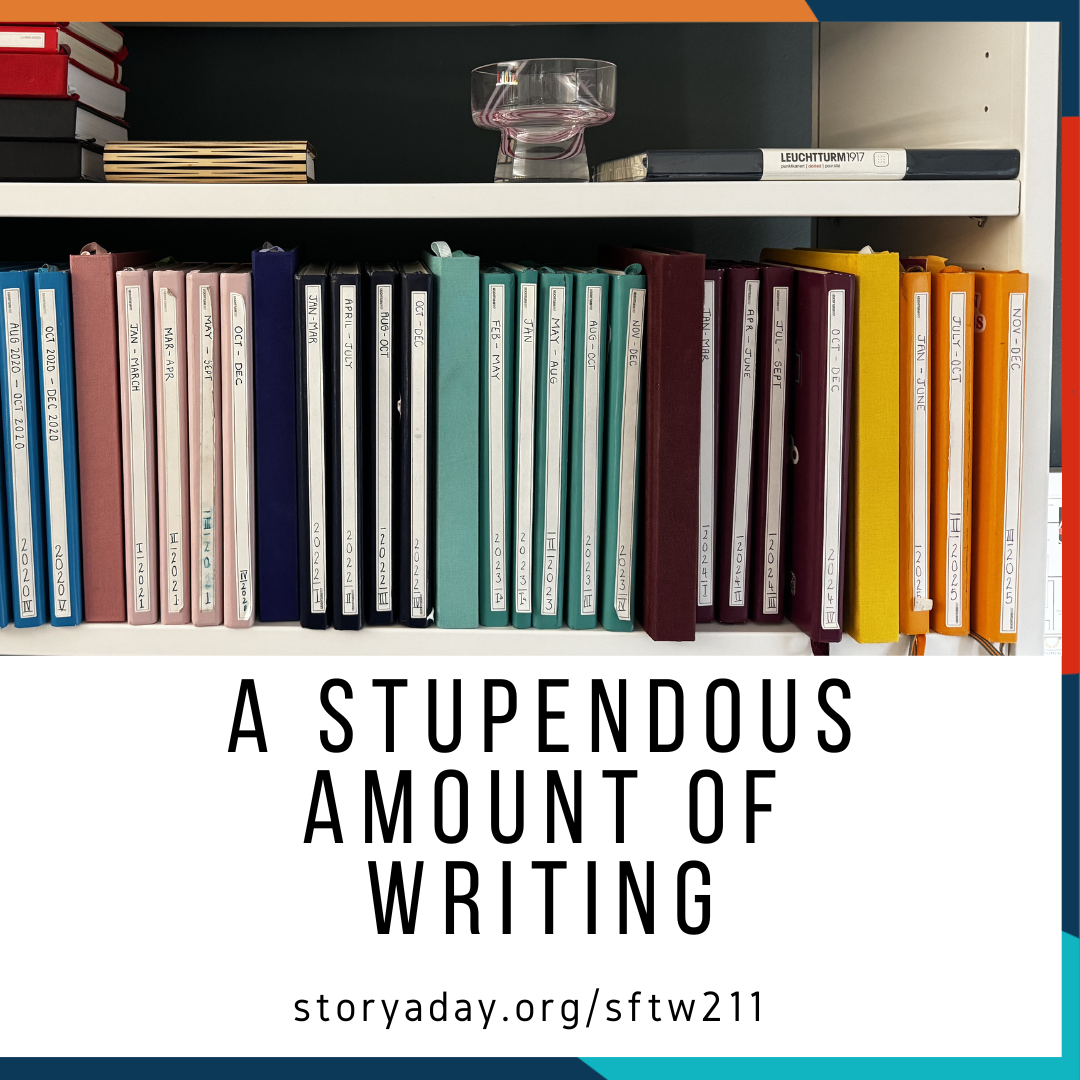
A Stupendous Amount of Writing

It’s tempting to think that other writers have it easier, or other times were easier on writers.

  • Wasn’t it easier to get published when there were more independent publishing houses?
  • Wasn’t it easier to make a living at writing in the golden age of magazine publishing?
  • All those other writers who are selling their work must have some kind of cheat code that they’re not sharing with us, right?

This week I read the editorial in the February 1951 issue of Galaxy Science Fiction magazine, a relatively new publication at the time. The magazine was making its mark, in part, by offering the highest rates in the market in order to attract the best writers. And they did—publishing Brandbury, Asimov, Clarke, Del Ray, Simak, in their primes.

But here’s a snippet from the editorial that I found weirdly encouraging. Editor H. L. Gold was trying to explain to readers how the economics of the writing business work, but I think he left an important message for us writers, too:

“Counting false starts, stories that won’t work out, stories that shouldn’t have been written at all but seemed good at the time, research, productive labor, etc., it takes a stupendous amount of writing even at the highest rates to support an author and his family on magazine sales alone.”

-H. L. Gold, Galaxy Science Fiction, February 1951

There’s your cheat code: there is no cheat code.

There’s just ‘a stupendous amount of writing’. 

Which we love to do, anyway, right?

Looking At The Wrong Metric

When people think of success as a writer, they tend to measure external, visible rewards: sales, income, awards, praise, etc.

But the rewards, if we’re honest, hit most deeply in those moment when a story draft pivots towards it’s real purpose, when you suddenly know what the story is really about; or when you realize you’ve revised it as far as you can, and it’s ready to be read by someone else.

The real reward is in the writing. 

What stalls a lot of people is the sense that you’re doing it wrong if you’re making ‘false starts, stories that won’t work out, stories that shouldn’t have been written at all but seemed good at the time…’

If you feel like you’re ‘not a real writer’ because it requires a stupendous amount of writing to generate the occasional piece that works, H. L. Gold would like a word…

He left those words in his editorial to justify paying the highest rates on the market; and they serve to remind us writers, that this was never easy. And that’s OK. 

Write a stupendous amount this week

If you’re an ambitious* writer, you have to write a stupendous amount to reap the rewards you’re after.  It’s not a race or a competition. You don’t have to burn out. But you do have to write. Probably more than is comfortable.

(*And ‘ambitious’ doesn’t have to mean ‘support myself financially via my writing’. That might be part of your ambition. But I suspect the true ambition is to do the best work you’re capable of.)

StoryADay May is an opportunity for you to find out what ‘a stupendous amount of writing’ feels like, over one month’s time. Are you capable of pushing through, writing when you don’t feel like it, and giving up on those ‘stories that should never have been written’?

If you want to feel the sharp satisfaction of success – whether that ‘success’ is ‘a day of good writing’ or ‘a story sold’, both are valid – remember that ‘a stupendous amount of writing’ is the baseline. It’s the thing that helps you find the stories, tell them well, and sense your own progress.

It’s OK if you don’t want to do all that work. If you have better things to do with your time, by all means do them.

But if you’re floating through life waiting for it to become easy I have some bad news: the struggle is frustrating, and annoying, and sometimes painful, but it’s also where the rewards lives.

What will you write, this week?

Here are the most recent prompts from the StoryADay challenge

Day 17 – A Critical Day, from Mary Robinette Kowal

Day 18 – Expanded Idioms, from Julie Duffy

Day 19 – Inspired by Artemis II, from Julie Duffy

Day 20 – Making a Grocery List, from Brenda Rech

Day 21 – The Nitty Gritty, from Ruby G. Dubois

Day 22 – The Hero of their Own Story, from Julie Duffy

Day 23 – Beyond Sound and Vision, from Elizabeth Twist

Not sure how to get started with prompts? The StoryADay 2026 Handbook has custom warm-ups and brainstorming exercises designed to catapult you into your day’s writing. Get it now
(NOTICE: PRICE WILL INCREASE ON JUNE 1, 2026)

StoryADay Challenge Handbook logo

Get the Essential StoryADay Challenge Handbook (the one that’s a short story course disguised as a challenge) from 2024. Video, audio, written lessons & captions
START HERE

Too Many Voices

For when you want to Do All The Things…

Are you sick of people telling you what you should be doing? (I know I am!)

There are so many things a writer ‘could’ be doing (social media, courses, mentorships, retreats, conferences, residencies…)

And only one thing a writer must do: write.

It’s easy to be distracted by the former, to the detriment of the latter.

So Much Noise

After the New Year lull, we’re hading into a season where it seems everyone is inviting you to attend a writers’ conference, a course, a retreat, a summit…and you’re going to have to tune most of it out—along with the FOMO—if you want to do any writing.

In my experience, the best way to stay focused and keep making progress is to limit your options: find one group where you belong, one teacher or annual conference that works for you, and then tune out the rest…for now.

Signal vs Noise

How do you identify the places that work for you?

There’s some trial and error, but here are some questions you can use while you’re evaluating different options:

  • Does showing up for these events make me more productive or just aspire to be more productive?
  • Do I come away from these events exhausted or exhilarated?
  • Does belonging to this group fill me with a restless energy to create, or do I feel like showing up at the event/class/conference ticks the creativity box and I can do nothing until the next scheduled event?
  • Am I inspired to write more, by the people around me?
  • Do I often learn something new that I can put into practice in my own writing right now, or is the teaching at the wrong level/stage for me?

If the answers to these questions are ‘yes’, stick with those groups, conferences or teachers until you start to answer ‘no’ more often than not.

The Most Valuable Question

That last question (“Do I learn something that I can put into practice in my writing right now”) is the really important one.

You might like the people or the teacher, but find that being with them doesn’t make you more productive. This can happen if:

  • They’re operating at a different level of ambition than yours
  • They’re working at a different skill level from yours (either far behind where you are or so far ahead that it’s not inspiring, it’s discouraging.)

It’s Not A Race

There’s so much to learn…but only so much you need to know right now.

Find the spaces that solve the challenges you are facing today.

Make progress on the challenges that face you today. Pause to celebrate and really FEEL that progress.

The rest can wait.

The Superstars Advantage
The fastest way to get better at writing stories is to write more stories — and reflect on them with other writers. That’s what the StoryADay Superstars group was built for.
You could do it alone, but why make it harder than it needs to be?
Find out more