Blog

Tuesday Reading Room – The Standard Of Living by Dorothy Parker

from Fifty Great Short Stories(Milton Crane, Ed. Bantam Classics reissued 2005)

I’m working my way through this short story collection which was first published in 1952 and starts with a lot of what would have been quite ‘modern’ writers’ stories: Dorothy Parker, Katherine Mansfield, Ernest Hemingway, V. S. Pritchett.

Only one story so far has featured a moment that seems as if it might change the main character for life. The rest are moments in time, even missed opportunities, made fascinating by the writer’s attention to the tiny details of their worlds. It strikes me that this is something you can do with a short story that you couldn’t do with a novel – at least not without annoying most of your readers. Novel readers expect something transformative to happen. Short story readers? Well, maybe they’re more forgiving because they haven’t invested quite so much time in the thing. But I still get annoyed with a lot of modern ‘literary’ stories where nothing happens and there is no sense of an ending. These stories all seem to pre-date that trend, thank goodness.

The Standard of Living by Dorothy Parker

I’m not usually a fan of descriptive writing, but in these short stories I’m finding it is making all the difference.

The Standard of Living by Dorothy Parker is a fabulous example of how a writer can flesh out a story whose plot is basically a build up to a simple punchline and turn it into something that stays with the reader. Parker creates two ordinary, shallow young women (girls, really), who are creatures of their time and trends and who think they are oh, so very sophisticated. They walk together on Saturday afternoons and play a sort of ‘imagine if you won the lottery’ game. Close to the end, something happens that reveals how far from sophisticated they are. That is the punchline, but the way they handle it is…well, I’ll leave it to you to discover.

What make the story, is the luscious, descriptive writing. It starts with a literal feast of words:

They lunched, as was their wont, on sugar, starches, oils, and butter-fats. Usually they ate sandwiches of spongy new white bread greased with butter and mayonnaise; they ate thick wedges of cake lying wet beneath ice cream and whipped cream and melted chocolate, gritty with nuts. As alternates, they ate patties, sweating beats of inferior oil, containing bits of bland meat bogged in pale stiffening sauce…”

And it goes on. Are you starting to get a feel for who ‘they’ are yet, from this description? Who might they be? Parker gives us another big clue.

They ate no other kind of food, nor did they consider it. And their skin was like the petals of wood anemones, and their bellies were as flat and their flanks as lean as those of young Indian braves.

Ah yes, they are those despicable creatures: young women! (Can you guess I’m staring aghast at the rapidly approaching 4-0?)

Only now, half a page in, does Parker give our characters, names, station, a bit of backstory. In one paragraph she tells a lifetime. She says a lot with few words ending with:

Each girl lived at home with her family and paid half her salary to its support.

Aha! These are not high-society misses at all. These are working girls affecting a life of leisure.

(I’ll freely admit I loved that sentence in part because it captures the lives my grandmothers lived before they were married, but how many young women – or men – would do that today?)

Every description of the girls is full and sensual and tactile and fixes them in time and space.

They wore thin, bright dresses, tight over their breasts and high on their legs, and tilted slippers, fancifully strapped.

Even their state of mind is shown viscerally from:

they held their heads higher and set their feet with exquisite precision, as if they stepped over the necks of peasants.

to later, when things are not going so well. Parker never says, “they felt bad”. Instead she writes:

Their shoulders dropped and they dragged their feet; they bumped against each other, without notice of apology, and caromed away again. They were silent and their eyes were cloudy.

It’s not how I write. It’s not my style. But I loved this story and definitely want to try out a story where I try out something more phsyical and real, like this one.


Do you write in a very descriptive way? Is your style similar in most stories? Do you like to read stories in the same style as yours, or do you also enjoy stories in a radically different style? Tell me how you read.

[Markets For Writers] Ploughshares Emerging Fiction Writers Contest

Ploughshares literary magazine was founded in 1971 at Emerson College. This years Emerging Fiction Writers Contest is open for submissions from Jan 16 -Mar 15 2011

Ploughshares

Ploughshares Emerging Fiction Writer's Contest screenshot

Eligibility

We define an “emerging writer” as someone who has no book, has won no major awards, and who has published fiction in less than five national publications. (A national publication is any magazine or journal, online or in print, with an ISSN number.)

Works should be less than 5,000 words. Entry fee:$20

Full contest rules

How A Subsidy POD Company Made Publishers Pay 50% Royalties

The Author’s Guild last week declared that no contract should offer an author less than 50% royalties on ebooks[2. They seem to have <a href=”http://www.authorsguild.org/advocacy/articles/the-e-book-royalty-mess-an-interim.html”>modified</a> their stance a little].

15 years ago, it was rare to see a number larger than 12.5% in any publishing contract for primary rights. It was common to see 10% or 7.5%.

How Did We Get From 7.5% to 50%?

Let me tell you a little story about the ancient days of the Internet.

In 1997 John Feldcamp, a digital printing guy and Chris Kelly, a finance guy, decided to set up Xlibris as an ebook and print on demand service (the first time anyone had figured out how to offer true POD services directly to authors) .

In 1998, they hired me to help them change the world. Whatever else Xlibris became or did right or did wrong, it was founded — and operated for a long time — on the burning beliefs that:

  • No-one had the right to tell any writer to sit down and shut up.
  • We were going to help every writer master the new methods of delivery technology was opening up to them.
  • We did not deserve any ownership of their intellectual property in exchange for helping them distribute it.
  • The author should get 50% of the proceeds[2. On print books 50% of the profit was a lot less than 50% of the list price, which is why the company eventually started using different numbers and the word ‘net’, and sounding a lot more shady, even though it was the same thing. But on ebooks? 50% was 50% of list, minus transaction fees, and we didn’t even bother charging for those at first].

50%?!

Barbarians At The Gates

Most people in the publishing industry, even many established authors, predicted that POD and ebooks would mean the end of civilization, that the world would be filled with dross and that not all writers deserved to share their stories with the world.

Three years later, in 2000, the big kahuna of traditional publishing, Random House, made a substantial investment in Xlibris. I listened with astonishment and pride as their spokesman started saying things like “Yes, we’ll be offering 50% on ebooks. That sounds like a fine deal”. I grinned to myself because behind Erik Engstrom’s words I heard the strong “Feldcampian” influence (John was not only extraordinarily clever, he was incredibly convincing).

From 50% to 25% in 8 Short Years

Eight years later Engstrom was long gone and Random House was changing the policy to 25%. Lots of other things have changed too: Amazon, Kindle, Nook, Apps…It looks like ebooks will eventually replace print books as a major sales stream. But authors will only get 25% royalties on ebooks, and the big publishers will get moremore of the profit than ever before.

Last week the Author’s Guild finally snapped and issued this outraged math lesson to illustrate the realities of the 25% royalty:

“The Help,” by Kathryn Stockett
Author’s Standard Royalty: $3.75 hardcover; $2.28 e-book.
Author’s E-Loss = -39%
Publisher’s Margin: $4.75 hardcover; $6.32 e-book.
Publisher’s E-Gain = +33%

“Hell’s Corner,” by David Baldacci
Author’s Standard Royalty: $4.20 hardcover; $2.63 e-book.
Author’s E-Loss = -37%
Publisher’s Margin: $5.80 hardcover; $7.37 e-book.
Publisher’s E-Gain = +27%

“Unbroken,” by Laura Hillenbrand
Author’s Standard Royalty: $4.05 hardcover; $3.38 e-book.
Author’s E-Loss = -17%
Publisher’s Margin: $5.45 hardcover; $9.62 e-book.
Publisher’s E-Gain = +77%

from The Author’s Guild site

The Rights Of Authors

The fact that my bosses convinced Random House, 12 years ago, to use the words ‘fifty percent’ is huge. I believe that Feldcamp and Kelly made 50% a number we writers can ask for today without being laughed out of the room (they endured that several times, on our behalf).

Some of the authors who hailed the ‘publishing services’ companies as Visigoths are now listing their own out-of-print titles with Amazon (at a 70% royalty rate) and keeping them in print independently via POD. They are demanding their due from their publishers, on a scale proposed by the former barbarians at the gate.

I am proud to have been one of those barbarians. And I am proud to have been friends with the men who smiled up at the publishing Caesars and convinced them to agree, for eight shining years, that 50% was, yeah, equitable.  The royalty and distribution debates of the future will be shaped by what they did back in the 1990s.

Writers, join me in raising your glasses today in a toast to Mr. John Feldcamp and Mr. Chris Kelly, founders of Xlibris, Kings of the 50% royalty.


Do you want to become an insanely productive writer? Need a big boost? Need a challenge? Sign up for the StoryADay Advance List to be among the first to hear about this year’s StoryADay May Extreme Writing Challenge. Or read more at www.storyaday.org


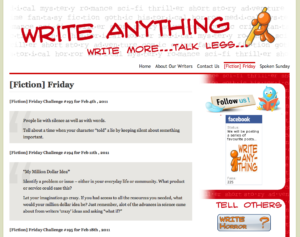
[Markets for Writers] Fiction Fridays at Write Anything

This one is less a true ‘market’ and more a community writing opportunity.

Fiction Fridays at Write Anything

The excellent folks at Write Anything (a multi-author writing blog) put together a challenge every Friday. You write, you post it at your own blog and you post a link at their site. Simple!

Upcoming themes include: “The Million Dollar Idea”, a Valentine’s theme, and a challenge to write a story in an 1880s, Western town.

From the website:

How To Play:

1. Check this page for the weekly challenge.

2. Write for a minimum of 5 minutes… AND THEN KEEP GOING!

3. NO editing. ( well.. do the obvious spelling and punctuation.. but nothing major)

4. On Friday, post it to your blog.

5. Come back to Write Anything and leave the link to your post using the Link generator.

6. Visit other’s posts and leave constructive comments.

7. Use Twitter (with our hashtag of #fictionfriday) or Facebook etc to tell your network about the stories posted up….

They also encourage you to record your story and submit the link for Spoken Sunday. I’m a real sucker for both reading aloud and listening to other people read aloud, so I’ll definitely be doing this!

Writers’ Corner: How Do You Feel About Contests and Facebook Groups?

Thanks for all the great feedback about the user blogs. It’s a relief to know I can sidestep that technical challenge. Your comments helped me stop worrying and move on, so thanks. On that note, here are a couple of other questions up for discussion:

chat

FACEBOOK GROUP

Popular writers’ blog Writer Unboxed recently opened a Facebook Group to complement their website, so now their readers can start discussions, not just comment on blog posts.

I have some opinions on whether or not StADa should start a Facebook Group, but I would like to hear yours. Should we have a Facebook Group?

COMPETITIONS

I also wondered if people would be interested in a StoryADay May competition, with judges and prizes and all that. You could opt to submit your best one or two stories at the end of May and we’d have judges and prizes and all that good stuff. Would that seem like fun or would it introduce an element of “Oh crap, this needs to be good’ into what is supposed to be a free-floating writing extravaganza?

Thanks again for your feedback!

Delegate Your Way To Writing Success

Part of the Time To Write Series. Interested? Subscribe to the blog


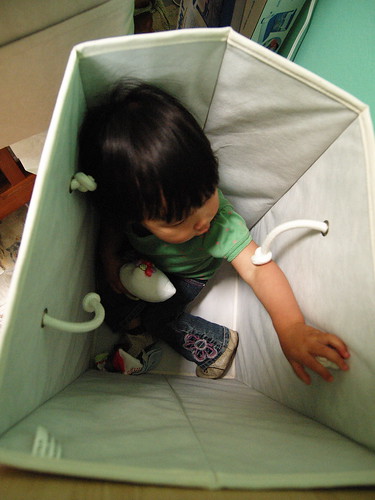
Inside the Box 2289
Do try to make sure the tasks you delegate are age-appropriate!

When my children were tiny I didn’t do a lot of writing. But there would come a day when I simply HAD to write. With a toddler in two, however, it became almost impossible to get through a full sentence without hearing that darling little voice yap,

“Mama? Mama! MAMA!!!”

I got to the stage where it was quite a relief when my boy unexpectedly ditched “Mum” and started calling me by my given name. At least it took a while for that to start to grate on my nerves!

The Delegation Revalation

One fateful afternoon, when my son — previously happily playing with toy cars at my feet — suddenly popped up and asked for a drink. For the third time that hour. I groaned and tore myself away from my half-finished sentence to fetch him a drink.

Then it hit me. My job as a parent was not to raise him to be helpless. My job as a parent was to teach him self-sufficiency. So what if he was only 3?

I started delegating.

That day I moved some plastic tumblers onto a low shelf in an under-the-counter cabinet and made a big deal of at last unlocking the water dispenser on the fridge. Sure, I had to clean up a few spills, but it was a price I was willing to pay to get a few uninterrupted minutes.

We quickly moved on to solo hand-washing, using a stool to get the toothbrush and toothpaste (creating a few precious extra minutes before bedtime). Then I packed away any trousers that didn’t have an elasticated waist and presto! I was freed from having to accompany him to the bathroom!

How Much Can You Give Away?

As the kids have grown, so has my hunger for writing time.

I now delegate all kinds of things.

  • Where I used to be in charge of bath-time and bedtime, my husband and I now share bedtime duty.
  • When I was deep in the crunch of StoryADay last May my seven year old, a-hem, learned how to make peanut-butter and jelly sandwiches.
  • While I toiled on my novel last November, my husband taught the boys how to fold their school clothes and put them away neatly.

I could feel guilty about deserting my family when I feel the need to write. Or I can celebrate my awesomeness as a mother who cares enough about them to teach them the life skills they will need when I eventually kick them out of my house. (Ten more years, Eldest. I’m counting.)

Delegation can be fun!

It’s not always, easy of course. Things go wrong. There is often a learning curve for the people you’re delegating tasks to. There might be occasional tears.

But stick with it. You CAN find ways to nudge the people around you become more independent, while also clawing back some of your precious writing time.

What about you? What one task will you try to offload this week? What poor helpless soul will you set on the road to independence?


Part of the Time To Write Series. Interested? Subscribe to the blog