The Submission Echo

Listen carefully, writers! Do you hear ‘the submission echo’?

or: Why Shouting into The Void Isn’t Always Bad…

Writing and submitting manuscripts can be discouraging. 

It can feel like shouting into the void. 

You send your stories, your queries, your pitches, out into the world and hear…nothing—-or ‘no—so often you start to “wonder what’s the point”?

I’m always preaching about the benefits to you of doing the work anyway, but recently I discovered another benefit, that I’m calling ‘the submission echo’, and it came after a flurry of ‘shouting into the void’, myself.

The Little Story That Couldn’t

I’ve been through a spell of ‘not sending things out’ and now I’m in a season of sending stories out to find their place in the world, again. And there’s a lot of waiting around for answers.

This week the answer was ‘no thanks’. 

The publication I had lovingly crafted a story for, didn’t want it.

Hmmph!

But…This one didn’t sting as much as some other ‘non-acceptances’ (I’m not using the R word!) because this one had brought me much more than an opportunity to be published.

This story had been a challenge to write. I’d had to research cutting-edge science for it. I’d walked away and come back to it. I’d enjoyed the process. Some readers I gave it to it to enjoyed it. 

In the end, I simply like this little story.

That’s why I was so surprised that the ‘no thanks’ didn’t sting as much as I expected, and here’s why:

I noticed the ‘submission echo’.

The Submission Echo

That’s what I call the effect when creativity begets more creativity, courage begets courage, and one story drives you to write more stories.

Lots of surprising things happened after I submitted that story:

  • Yes, the story had been tricky and the research had stretched the limits of my understanding of a particular field…and energized me. It reminded me that I love writing.
  • Yes, it took courage to push the ‘submit button. But the little hit of excited dopamine made me want to do it again. Which meant more writing, more market research, more wrangling with tricky plot points…only now, that felt exciting, not overwhelming.
  • And yes, I gained renewed confidence in my ability to push through a problem in a story. (Since submitting the Little Story That Couldn’t, I have added three new scenes to my previously-stalled novel-in-progress.)

Shout Into The Void

When writers tell you not to fear rejection it’s not just because acceptance is a numbers game1.

It’s also because pushing yourself to finish the story, polish the story, take a chance on showing it to someone…all these things make you uncomfortable and it is in the discomfort that we grow.

Submitting stories isn’t the only way to force yourself to stretch, and grow as a writer, and next week I’ll send you some other ideas on how you can push yourself to grow as a writer.

But I hope you push yourself to do something that feels like ‘shouting into the void’ in your writing life, this month…because you never know what you’ll hear in the echo.

storyaday graphic divider

Until next time: here’s a new episode of the podcast, talking about this story; the fine line between ‘excuses’ and ‘reasons’; and a writing prompt centered around holidays. Check out the podcast, here.

Keep writing,

Julie

P. S. Need more practice writing stories you can send out into the void? Consider the StoryAWeek newsletter: 52 weekly lessons and writing prompts. Find out more.

  1. Assuming you are a halfway decent writer, the more stories you send out, the more likely you are to hear a ‘yes’ ↩︎
What Would You Do With Fortune & Fame?

Why do YOU want to write?

What if your writing could really help someone?

This week I became aware of a project from fantasy writer Brandon Sanderson: a “challenge coin” offered freely to anyone struggling with depression, that a,  is a beautiful collectible item and b, contains a QR code link to resources to help people with mental health issues.

(You can find out more here. If you are someone who deals with depression, you can get the coin for free. If you just like Brandon Sanderson and want to support his work—or collect All The Things—you can buy a coin there, too. There is no ‘test’. You are invited to self-select.)

The Arts As Their Own Reward? Yes, and…

I’m a big fan of encouraging people to write for it’s own sake: for the rewards you get from the process.

But that doesn’t mean I think you’re somehow ‘selling out’ if you want to make a living from your craft. 

In fact, if that’s your path, I hope you make a fortune from your writing.

I think writers are exactly the kind of people who should be successful and rich.

Brandon Sanderson is an example of how that success can look, in the hands of someone who spends all their time thinking hard about what makes humans tick (i.e. a writer).

Do The Work

Dreams of fame and fortune, and all the good you’ll do with them, are lovely, and can be inspiring in the tough times, when you’re starting at the fourth revision of a manuscript, wondering if you’re making it better or worse.

But you still have to do the work. 

Sanderson didn’t become rich and successful on the strength of having written one book. He writes a LOT. Obsessively, in fact. 

You do not have to write obsessively in order to become successful–there are plenty of examples of people who have a slightly more balanced approach and still do fine–but you do have to write.

  • Actually-Writing,
  • Really-Revising,
  • Courageously-Engaging with the publishing industry/readers,

These must be serious activities for you, if you want success as a writer.

Don’t Go It Alone

Another lesson from Sanderson that I’ve noticed over the years is that he doesn’t try to do it alone. 

  • He worked to develop his own style, but then he went to conferences to learn the business.
  • He formed a podcast with other writers, to share what they knew with the community of writer-admirers. 
  • He formed a company to deal the the growing business demands of being a prolific and successful author.
  • In his announcement about the challenge coins I noticed a lot of ‘we’ language.
  • He came up with the idea, but it was clear that there’s a team behind him coming up with smart ideas (like: what should go into the resource page; what to do about the tension between their desire to give them away to people who need them and also satisfy people who just wanted the coins because they’re collectors…)

The myth of the solitary writers is just that…a myth.

The only stories about solitary writers I can think of are stories that don’t end happily. Any successful, modern author’s ‘acknowledgments’ section runs to several pages.

How We Do It

Here in StoryADay-land, we get together to write every May: taking on a huge, ridiculous challenge, just to see what we’re made of. We post about our successes and our less-than-successes. We share and commiserate.

And we do workshops and hangout and co-working writing dates together, because doing this together is just way more fun. And more sustainable.

I hope you have a supportive community of writers around you.

And if not, keep your eye on your inbox for an invitation to join us for an end-of-year get together for the StoryADay community, that will also help you plan for a 2026 you can be excited about.

A Fun Thought Experiment

What would you do with your fame and fortune if you made it big? Leave a comment and let us know!

Keep writing,

Julie

P. S. Need more practice turning everyday moments into key scenes in your stories? Consider the StoryAWeek newsletter: 52 weekly lessons and writing prompts. Find out more.

It’s The Process, Not The Prizes

Why do YOU want to write?

To have this article read to you subscribe the podcast, or StoryADay on YouTube

In his 2003 Nobel Prize Banquet speech, honoree and author J. M. Coetzee used his moment on the stage to reflect on what a shame it was his parents hadn’t lived to see this day: 

“Why must our mothers be ninety-nine and long in the grave before we can come running home with the prize that will make up for all the trouble we have been to them?”

-J. M. Coetzee – Banquet speech. NobelPrize.org.

I thought this was an odd, and dispiriting way to thank the Nobel committee. 

Perhaps it struck me because I lost my dad in the summer and am going through the process of getting used to not being able to tell him things and see the reaction on his face.

But what I know in my bones is that, though he would have been tickled pink by my current and future achievements, his pride in me was based on who I am, not any big outcome, or prize. (And yes, I know I was privileged to have pretty awesome parents.)

It’s Not The Prizes

It’s not the big moments that make up a life—or a writing practice.

It’s the millions of tiny decisions and actions we take, day after day, that tell people who we are, and that add up to a life.

  • It doesn’t matter if your writing goes well today. It matters that you did it.
  • It doesn’t matter if you wrote 5,000 words today. It matters that  you come back and add more words, soon.
  • It doesn’t matter if your first draft is ropey. It matters that you finish; that you summon up the courage to revise it, and revise it again; that you decide you are bold enough to share it.
  • It doesn’t matter if your writing is ‘on trend’. It matters that you spend your time working on something that delights you—even as it frustrates you; something that only you could write.

Who Tells Your Story?

After playwright Tom Stoppard died this month, a widely-shared letter appeared in the UK newspaper The Times. 

In the letter, surgeon and cancer researcher Dr. Michael Baum recounts how, while attending a performance of Stoppard’s play Arcadia, he was introduced to Chaos Theory, which changed his thought process about a thorny problem in treating breast cancer. He ends the letter,

“Stoppard never learnt how many lives he saved by writing Arcadia.”

Prizes are nice.

Publication acceptances are nice.

Being able to make some money from your writing may, or may not be, nice depending on how you feel about turning your avocation into a job.

But writing is weird.

It’s a way to place our ideas into the heads of people we’ll never meet. 

It’s a method for manipulating the emotions of people in a future we might not see.

It’s a stone cast into a vast pond, causing ripples we can’t possibly track.

The Point

The work is the point.

The work is the starting point.

We might never receive the prizes, the publication, or the acclaim, but we can certainly never receive them if we don’t build the habit of doing the work. 

And doing the work has to matter enough to you that you would do it even if you never hear that your parents are proud of you or that you saved lives with your writing. 

You may never know what you writing means to other people.

What does your writing mean to you, and can you find a way to make that ‘enough’?

Keep writing,

Julie

P. S. Need more practice turning everyday moments into key scenes in your stories? Consider the StoryAWeek newsletter: 52 weekly lessons and writing prompts. Find out more.

Stop trying to be ‘important’. Do this in your writing instead

Do you lead an unremarkable life? Great! Use that to connect with readers!

I spent a lot of time in Scotland this year, for family reasons. 

Any time I could, I went outside: to walk in the woods – swinging my arms carefully to avoid the tall, triangle-leafed stinging nettles or stooping to squeeze between my fingers the low-growing wild garlic.

On other days I was magnetically drawn to the coastline – making my way over the dunes or rocks, through the powdery, dry sand that shifts underfoot, to the glistening ridges of packed sand beyond the high-tide line of stranded bladderwort seaweed.

Crouch down above the high-tide line to dig your fingers into the sand and you’ll first feel the warm, granular top layer, that seems soft and forgiving, only to quickly encounter a harder layer of cool, damp sand, resisting you. Dig closer to the water line and the wet sand will flow in and close around your wrist, like it wants you to stay.  

The Writer’s Lens

Consider the last line of the previous paragraph. Is the landscape I wrote about friendly? Or is  its grip sinister? 

If this was a story, you’d have to keep reading to find out.

As a writer it’s almost impossible to write about any experience without it turning into a metaphor for something else. We can’t help ourselves.

And that’s exactly what I want you to remember this week.

Writing Is About Creating Connections

Sometimes “Writing” seems like an ambitious and complicated aspiration. 

Do I have anything important to say? Who am I to ask people to listen to my words? Who’s going to care about my characters’ trivial adventures when the whole world is [gestures vaguely] like this?!

It’s important to remember that most people don’t have big, grand adventures every day. Or often.

Even if your characters are getting into dramatic scrapes in worlds we’ll never visit, the moments when your readers connect with them, will be the ones we recognize from this life: the moments of connection; the flash of nostalgia; the smell of a long-lost comfort food.

If you want to connect with readers, give them tiny, everyday experiences they can relate to. The more specific, the better.

Stand The Test of Time

Jamaica Kincaid’s 1978 short story “Girl”, is a list of advice on how to be a woman. But not just any woman.

Through the details Kincaid choses, the reader is invited to make assumptions about who is speaking–from their gender to their age, to the geographical location: 

“Wash the white clothes on Monday and put them on the  stone heap…This is how you iron your father’s khaki shirt so that it doesn’t have a crease…this is how you grow okra–far from the house because okra tree harbors red ants…”

But it’s not just a list of instructions. They, along with the occasional editorial comment, add up to a larger story in which the older woman imparts warnings and advice and leaves the reader with questions: Does the speaker want the ‘girl’ to be the kind of ‘good girl’ who just does what people tell her? What exactly does the last line of the story mean?

It’s a short pieces that ignores all the ‘rules’ about story structure, and yet people are still sharing it, 43 years later. 

What We Notice

I believe “Girl”’s lasting popularity has a lot to do with the specificity of the details in this story. They are what make it stand out. They are what root it in a particular place and a particular voice.

So don’t feel you need to aim to create something grandiose, pregnant with “capital-M-Meaning’. 

Just focus on telling a story that feels like it’s happening somewhere specific, with moments your readers can enter. 

And you do that by focusing on the small, everyday, universal details:

  • The smell of the tea roses on the bush by the bench where you sat with someone you loved;
  • The slow shuffle down a hospital corridor, repeated so often, you’ve memorized the posters on the wall: “Join the Rock Choir: Thursday evenings in the parish hall” “We buy second-hand mobility devices–call for a quote”;
  • The texture of the sand on the beach, where the wind off the ocean whips away your tears before you have to explain them to anyone…

Don’t worry about what your ‘point’ is; what grand lesson readers must draw from your writing.

Focus on the tiny moments, the delicate sensations, that make up a life, and the story will emerge.

You’re a writer. 

Write first. 

Figure out what you’re trying to say, in the process.

Keep writing,

Julie

P. S. Need more practice turning everyday moments into key scenes in your stories? Consider the StoryAWeek newsletter: 52 weekly lessons and writing prompts. Find out more.

StoryADay November 2025 participant badge

To Do Now

  • It’s nto too late: join us in StoryADay November. Sign up here
  • Pick a number of days that you will participate. Post your goals here 
  • Leave a comment below, confessing your remaining fears (and let me reassure you)

And I’ll see you in the comments, next month!

Why Before How

how a post-partum exercise class made me a more dedicated writer

Happy Friday, Writers.

I’m back, as promised, with a little Something for the Weekend.

First, a story, then some prompts:

Why Before How

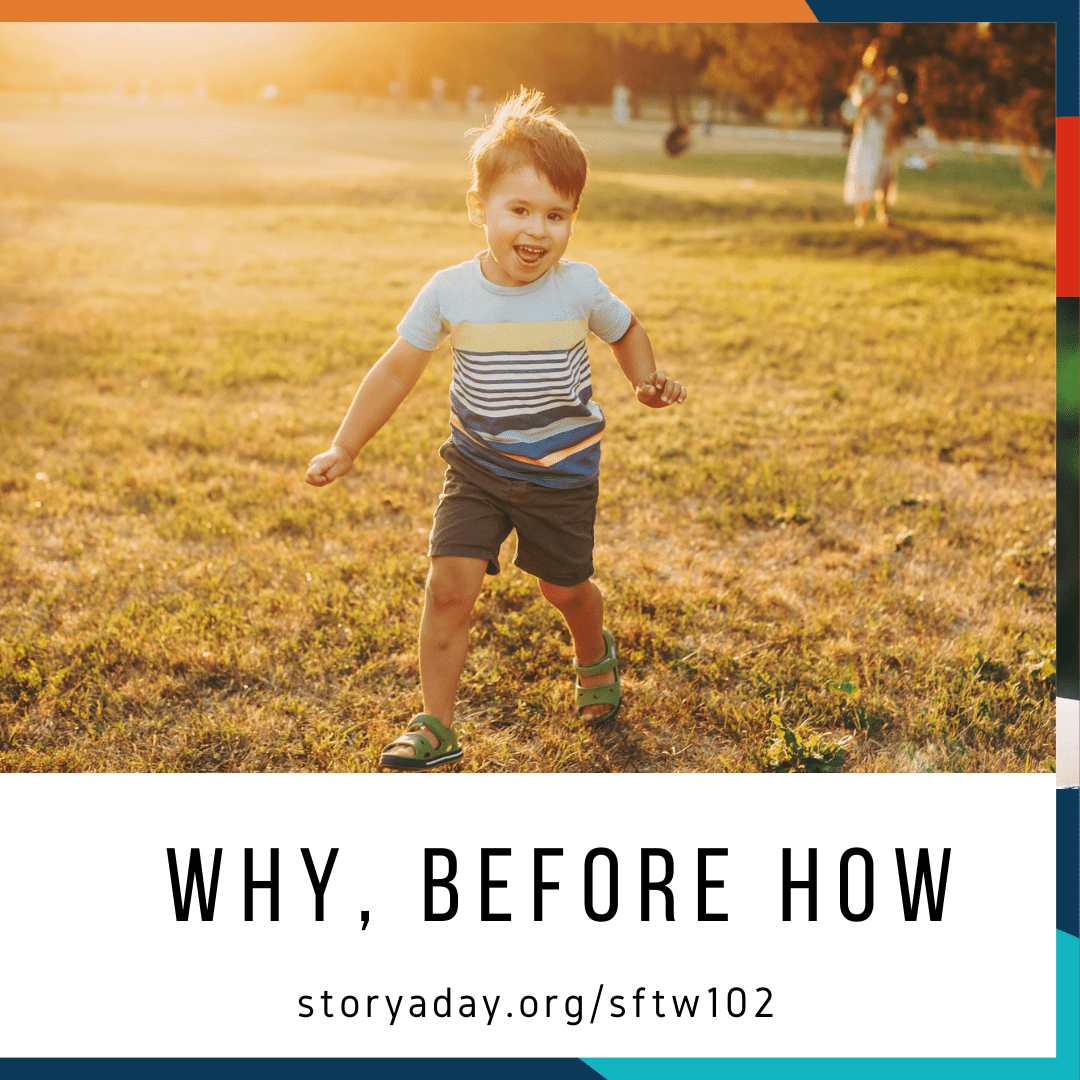
His chubby little hands reached out for mine and I raced up the grassy slope to scoop up my little boy and whirl him around. He’d never been in any danger. He just wanted his mum. So I ran.

This was the image I kept in my head, throughout the series of exercise classes I attended after I had my second kid. I wasn’t there to ‘get my figure back’

I was there because I wanted to be the kind of mum who could run to my kids if they needed me — or wanted me, or simply if I wanted to.

Every time I was tempted to stop leaping around like a fool in font of the mirrors, and catch my breath, I’d conjure up that vision and ask myself if I would keep going, if I was running to save one of my kids.

Knowing WHY I was doing a hard thing made it easier to live through the slog of the ‘how’.

As a writer it can be hard to sustain the long-term effort required to achieve the writing life you want.

Getting clear on why you are doing it, makes all the difference.

You’re not doing it ‘to become a best-seller’ (the writing equivalent of, ‘to get my figure back’ – something other people seem to care about more than we do…).

You’re doing it because you want to. Because it makes you happier. And that’s a good enough reason to put in the effort.

If you can, spend some time this weekend thinking about why you want to write that project you’re working on/avoiding.

  • What does it really mean to you?
  • What will finishing it do for you, in your deepest self?

Once you have the ‘why’, you’ll find it much easier to do the reps you need to do, to reach that goal.

Writing Prompts

Need some inspiration to jumpstart your writing? Here are a few more Story Sparks I shared in January:

(Each dose of inspiration is around 1 minute long and captioned)

To follow along with all the prompts, click here.

I’ll be back in your inbox next week. If you have questions or fears, or are stuck on anything to do with your writing, let me know. in the comments I’ll do my best to address your question in an upcoming missive.

Keep writing,

Julie

P. S. Those little kids I was training to chase? They’re just about to turn 20 and 22. Now I’m exercising for myself, because that long-ago class taught me that I was stronger than I knew…a feeling I want to hang onto! Likewise, it’s OK to pursue your writing to make someone else proud of you. But, stick with it, and you’ll soon find you’re writing to make you proud of yourself!