In which I caution you against looking for answers in the wrong places….
Back in the mists of time, when I worked in an office–before remote working, before video conferencing—we worked together, but separately, each in our own little cubicles.
From time to time we got up and wandered over to the coffee machine for sustenance—both of the caffeine variety and the human variety.
You’d see someone, ask about their day, laugh about shared customer-challenges, and wander back to your desk refreshed.
It worked because you were seeing people who shared common experiences (You knew the aims of the company, who the good bosses were, and that nobody should ever reheat fish in the office microwave).
Early online communities and social media were like that…but for stuff you actually did for fun.
Twitter, in 2007, was the online equivalent of the office coffee machine, but for writers and other freelancers who worked alone for most of the day; for people who knew nobody else in their zipcode who was still mourning the cancellation of “Firefly”; and where people with the same twist to their sense of humor could find each other.
So why doesn’t StoryADay have a free community, like so many other writing sites?
Well, when I started StoryADay in 2010 it actually did have a free community (a Buddypress forum that felt a lot like a Twitter feed), but it was hard to lock out the spammers, so I shut it down and went back to asking people to leave comments on blog posts.
Here in 2026 I still ask people to check in by leaving comments on blog posts, which feels impossibly retro now and yet, and yet…
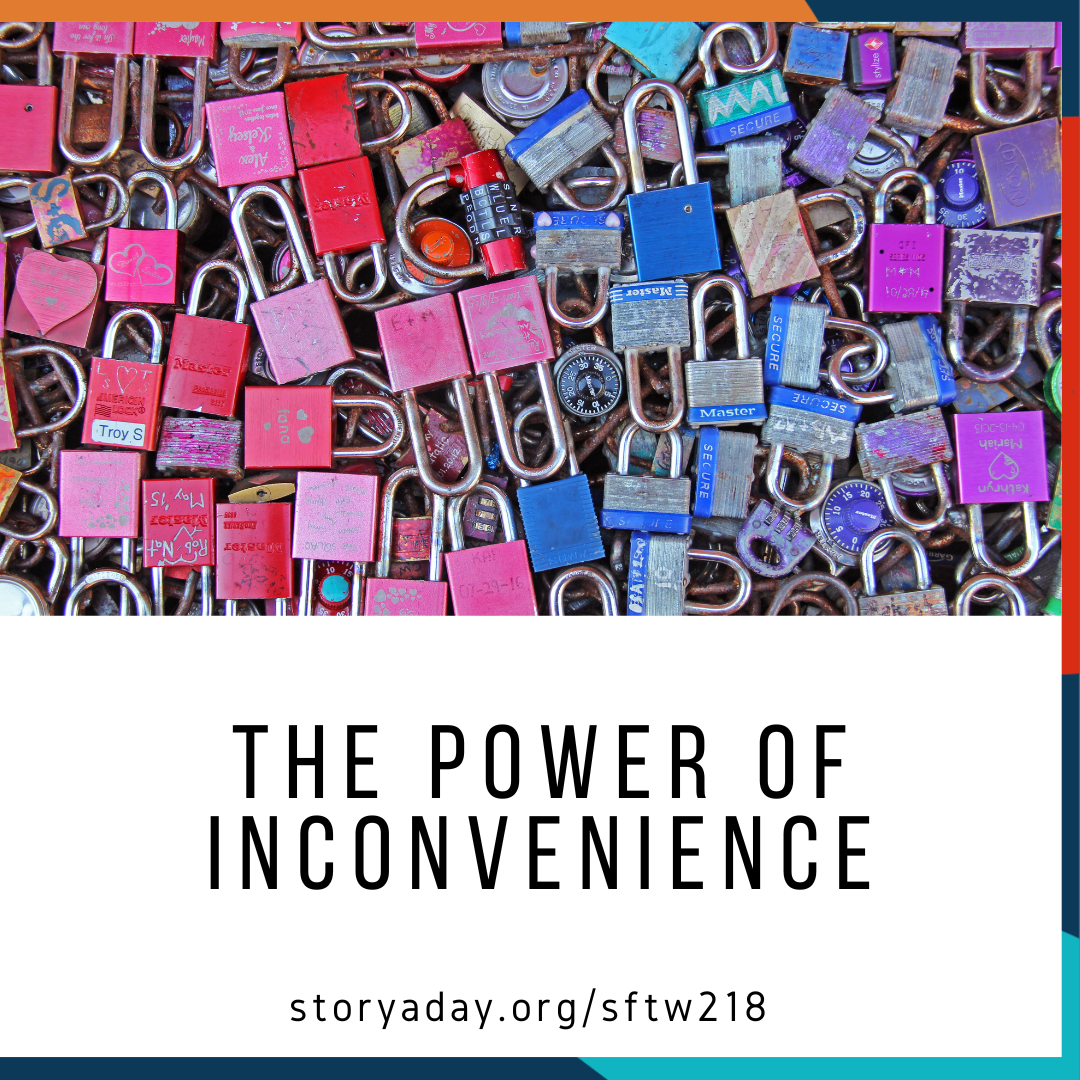
I’m increasingly coming to believe in the power of inconvenience.
If someone replies to your blog comment, you have to make the effort to come to the site and find it to reply to it.
It doesn’t pop up on your phone and pull you away from whatever you were thinking about a moment ago. You have to set aside time to pull up StoryADay.org and find the post and see if anyone replied.
You can choose not to.
And if you choose not to, what have you really lost?
I, as the host of StoryADay, have lost the opportunity to hook you into my platform day and night, and so, StoryADay has never gone viral, never had a splashy influx of hundreds of thousands of users, never had companies beating down the door to sponsor posts.
And, equally, we’ve never had any problems with bad behaviour, or people losing days–or weeks–to feuds and drama.
What we have had is thousands of writers who drop by to be inspired by a prompt, share a cheery word of encouragement with another writer, or leave a comment to tell me a story they started during a previous StoryADay May is just about to come out in XYZ Magazine.
Maybe I should have built an addiction machine, where I could sell my captive audience into ever-more-expensive programs until I could hire a bunch of coaches to replace me and retire to a windswept island off the coast of Scotland.
At any point, I could have hosted a message board or forum at the site, started a Facebook group or a sub-Reddit, formed a Patreon, or a MightyNetwork, or a Skool, a Substack or a Discord (I mean, doesn’t everyone have a Substack or a Discord, now?)
But, it has always come back to this:
My aim is to encourage you to write more.
And I’ve never been able to convince myself that creating a fun place for you to hang out in your spare time, instead of writing your next story, was my best move.
(And I certainly didn’t want to spend all my time moderating comments.)
But what about your Superstars Group, I hear you ask; don’t they have a community?
Yes. the StoryADay Superstars group—my subscription-based membership group for writers who want support as they create their writing practice—has a text-based community, but it works for the reasons that the old workplace coffee machine worked:
- There aren’t very many of us (Superstars will never have more than 150 people in the group, and I suspect the sweet spot is somewhere under 100), so everyone feels seen.
- We all share the same experiences: writing sprints, workshops, critique weeks, hangouts and coaching
- We all understand the group’s aims: to get us all writing more, and feeling more successful.
- People have made a commitment, in order to be there. By paying a membership fee they have said to themselves: I am a writer. I take this seriously.
It’s fun to pop in and leave a comment or answer a question, and get that deep sense that, no you are not the only one who struggles with this or that aspect of the writing life.
But the chatter is never overwhelming.
Just like when I was back at the office, I think we feel the peer pressure of the group subtly saying, ‘ok, that was fun, but isn’t it time to get back to work, now?’
Why am I telling you this?
In part, because I wonder if you think it’s strange that I don’t have a more modern way for you to connect with other writers, and why the most effective way is behind a paywall.
But mostly, I hope you’ll heed this warning: there are a million and one writing communities out there, of varying quality. Some are free. Some promise the world. Some will suck the life right out of you and most will eat all of your free (aka ‘writing’) time.
If you find yourself in writing Discords or Substack communities, or Facebook groups that don’t propel you away from the group, inspired to write; and instead you just keep scrolling, scrolling, scrolling…I’m going to suggest that you step away.
Maybe just for a day or two. Try it out.
Trust me when I say:
- You don’t need another tip on how to write dialogue.
- You don’t need to know who’s saying what about AI this week.
You need to write your next story. - You need to finish that chapter.
- You might need to go and read a real book, to get inspired.
- Or perhaps you need to go outside and feel the wind on your face, and gaze into the deep blue of the twilight sky for an unreasonably long time, and be struck, once again, with awe at your speck-like existence in this improbable, ridiculous universe.
This is what I remind myself every time I see another writer, or writing teacher, offering an invitation to their free Discord and wonder, “Should I be offering that too?”
And this is what I hope you’ll remind yourself any time you are temped to go online to find the answer to a question that you know, deep down, can only be found inside yourself, and birthed into the world through the process of you fumbling your way through drafts, and revisions, and through the messy, frustrating joy of this thing we call writing.
Actually-writing harder than scrolling a ‘community’ feed. It’s scarier. And, in the end, sweeter.
Keep writing,

Julie Duffy