RIP NaNoWriMo

I’m taking a moment this morning to mark the passing of NaNoWriMo as an oganization.

Theirs was one of the creativity challenges that inspired me to start StoryADay May for short story writers, in 2010 (NaNo’s 11th year).

(Fun fact: I even got founder Chris Baty’s blessing)

The end has been undignified, but I think NaNoWriMo’s real legacy will linger in the memory of its celebration of everyone’s right to be creative, to write our own entertainment and to do it in our own way.

(Pre-1999, pre-NaNo, pre-YouTube our culture had been one that suffered decades of tight gate-keeping on creativity’s tools of creation and distribution. NaNo was a glorious middle finger to all the people who said only certain types of people should dare to write.)

Its legacy will also be in the many, many writers who taught themselves how to stick with a project during NaNoWriMo and the many books that followed.

The Fall

It’s hard to grow and scale a business, even (especially?) a non-profit one. And it’s hard to run a writers’ organization—we are passionate, opinionated, insecure, clever, thoughtful, and prickly.

The choices the NaNo board made for their community were naieve at first, and disastrous later, but we can still applaud the spirit of encouragement, empowerment and generosity that were at the heart of NaNoWriMo for so long.

All good things, as they say.

What does this mean for other writing challenges?

Candidly, I’ve seen a drop off in participation in StoryADay May, too, though hundreds of people still enthusiastically participate and build that stack of first drafts to polish, and teach themselves how to persevere.

And, in truth, the challenge itself has become less important to the StoryADay writers, as we’ve built a close-knit private community and a looser, casual-acquaintance-type community around my workshops, podcast, and blog.

The StoryADay May challenge is still a highlight of the calendar, a way to take our writing both less and more seriously: more, as we commit to the practice; less as we try to write a ton of stories in one month.

(Perfectionism? Eat my dust!)

So RIP #NaNoWriMo. Writers will always need the kind of encouragement, permission and togetherness you stove for. We’ll continue to find each other, and push each other, and celebrate each other’s wins.

We just might not try to all get along in one place…

Onward

One day StoryADay will end. I will do my best to make it a controlled descent rather than a crash and burn, but that day is not today.

If you’re craving a little time-limited, creative frenzy, consider joining us for the 16th StoryADay May

Sign Up Here
I’m Talking About Practice

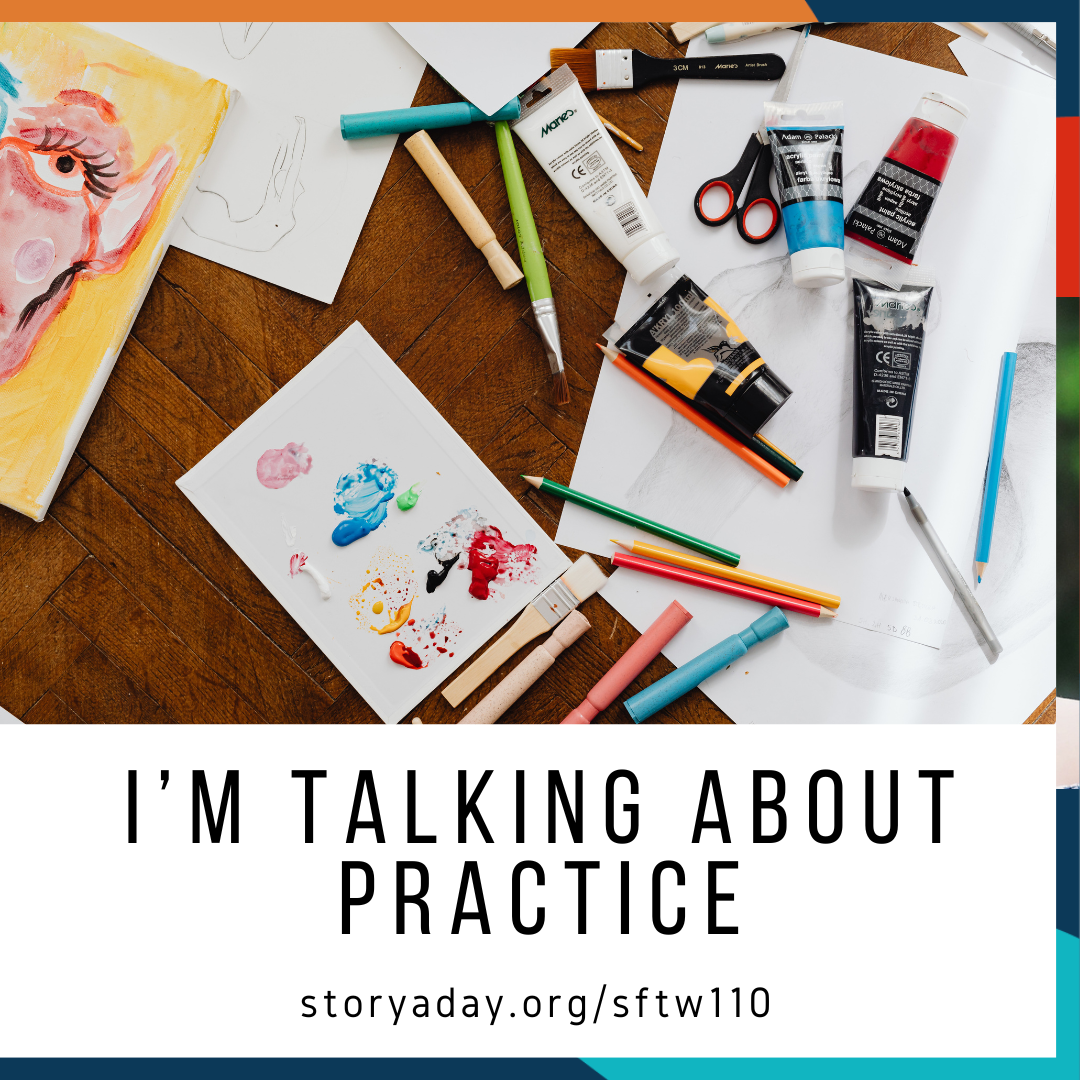
Visual artists keep sketchbooks. 

I’m not sure if it’s something they’re taught to do or something they’re compelled to do., but if you tried to tell a visual artist not to ‘waste their time’ on anything but the piece they’re trying to sell, they would blink uncomprehendingly.

The constant, unfinished, experimental sketches are essential fuel for their finished works.

We writers seem to have a lot more angst about doing writing that doesn’t ‘turn into something’.

  • Do you ever worry if you’re wasting time because you’re jotting down ideas or fragments of conversations? 
  • Do you feel pressure to be completing works and getting them published?

I think we feel this way, in part, because of the way “how  to write “reference books are written (Chapter 1: how to find ideas, Chapters 2-11: Craft techniques to develop those ideas; Chapter 12: how to get an agent, publisher, seven-figure book deal and then sell the film rights).

But a more powerful reason we feel pressure to craft finished pieces is that everyone can and does write, daily, even if it’s just text messages, and has been able to do it since they were a child. 

Writing seems ‘easy’ in a way that creating a painting or a sculpture (or writing a symphony), doesn’t. 

When the people in our lives ask, “when’s that book coming out” we feel judged (even if it’s meant in a supportive way).

And so we rush back to the Big Project full of good intentions and impatience, only to discover that crafting that big project feels like standing at the foot of Everest, in flip flops, and hoping to get to the top by next weekend…because we haven’t equipped ourselves properly, or kept in shape by doing sketches, crafting characters, drafting dialogue, and writing down our ‘what if’s on a daily basis.

An invitation to a training mission: This week, capture 3 Story Sparks a day, for five out of seven days.

Hand write them in a special notebook you carry everywhere or capture them in a note in your phone. Use a journaling (or journaling app) to add pictures and sound snippets, if that inspires you. 

Don’t worry about what you will do with these sparks. Just practice noticing how the world unfolds around you.

Keep writing,

Julie

Writing Prompts: Sensory Writing Series

A few years ago I put together a series of short story prompts aimed at helping you explore the different senses in your writing. You can use them in a larger work in progress, or you could write a series of short works that go together, tied up with the theme of ‘senses’.

  1. Smell
  2. Sound
  3. Touch
  4. Taste
  5. Sight

Bonus points: write about the fuzzier senses (sometimes lumped together as ‘proprioception’) that allow you to do things like walk downstairs without looking at your feet, stand up in the dark without falling over, and know how closely someone is standing behind you, even if you can’t see them.

Sneak Peek at some of the Guest Prompters for StoryADay May 2025

Get Ready to Write Every Day in May with Inspiring Prompts from Literary Legends

[25 March 2025] – StoryADay is thrilled to announce the upcoming 2025 StoryADay May challenge, set to inspire writers of all levels to write a new short story every day throughout the month of May. This year’s challenge includes exclusive guest prompts from some of the most exciting voices in contemporary fiction, including P. Djèlí Clark, Rich Larson, John Wiswell, Jennifer Hudak, Lori Ostlund and many more.

StoryADay May is a month-long writing event designed to challenge writers to commit to a daily writing practice and push their creative boundaries. This year, the challenge is made even more exciting with special guest prompts from award-winning authors who have contributed their own unique writing exercises. These prompts are crafted to spark new ideas, inspire creativity, and help writers explore fresh storytelling techniques.

Some of the literary luminaries who have joined this year’s lineup include:

  • P. Djèlí Clark, Hugo Award-nominated author known for his speculative fiction that blends history with bold new worlds.
  • Lori Ostlund, author of After the Parade and The Bigness of the World, whose beautifully crafted stories of human connection and transformation have earned her wide praise.
  • Rich Larson, whose gripping short stories and science fiction work have captivated readers worldwide.
  • John Wiswell, whose award-winning, inclusive fiction regularly appears in ‘best of’ anthologies.
  • Jennifer Hudak, an acclaimed writer celebrated for her short stories that explore identity, relationships, and the human experience.

These guest authors, along with others, are offering their personal insights and prompts to help participants unlock their imagination and make the most of the challenge.

Why Participate in StoryADay May?
StoryADay May isn’t just about quantity—it’s about creating a consistent writing habit, connecting with other writers, and honing your craft. Whether you’re a seasoned writer or just starting out, the challenge provides the structure and motivation to write every day. The guest prompts will help you approach your writing with new perspectives, while the StoryADay community provides a supportive environment to share your work and celebrate your progress.

How to Join:
Writers of all levels are invited to sign up for the StoryADay May challenge at https://storyaday.org/signup. Participation is free, and registrants will receive access to the daily writing prompts and community support throughout the month.

Don’t miss this opportunity to join a vibrant, creative community and make 2025 the year you build your writing habit—one story at a time.

About StoryADay
StoryADay is an online community dedicated to helping writers develop their craft and maintain a sustainable writing practice. With a focus on short fiction, StoryADay provides writers with challenges, prompts, workshops, and community support to help them reach their writing goals. Founded in 2010 by writer Julie Duffy, the challenge and community have become fixtures of the writing community, earning a frequent place on Writer’s Digest magazine’s, 101 Best Websites for Writers list

Maybe You SHOULD Be Writing

Some weekend reading and listening to inspire you to write…

I’m in the midst of asking writers I admire to contribute prompts for this year’s StoryADay Challenge. It’s nerve-wracking, and takes a little courage, but I do it.

Then, inevitably, when they say ‘yes’, I experience Big Emotions: Happiness and, weirdly, overwhelm. And I want to run away from my computer!

Today I caught myself feeling those feelings. I took a deep breath and asked:

What if I don’t let the Imposter Syndrome rage?

What if, by creating StoryADay May, I really HAVE created something awesome that people love to support and take part in?

What if I am doing good, and that’s good enough?

And so, I ask you the same question: what if you ARE good enough, as a writer?

Some Weekend Reading/Listening For You

img_5716-1.png
img_5716-1.png
previous arrow
next arrow

Discussion Time: How Do You React?

  • Do you ever struggle with receiving positive feedback on your writing?
  • Do you ever demur and dismiss people’s praise with an “oh, go on, you’re just being nice…”?
    What if you could stand your ground, sit in the discomfort, and let their praise sink in?
  • What would it do for you, if you could truly believe that your writing is good enough, of service to readers, and that you can accept praise?
    Would you become an arrogant monster? Or would you become invigorated and want to write more stories for people to enjoy (Hint: it’s not the first one).

Leave a comment and let me know

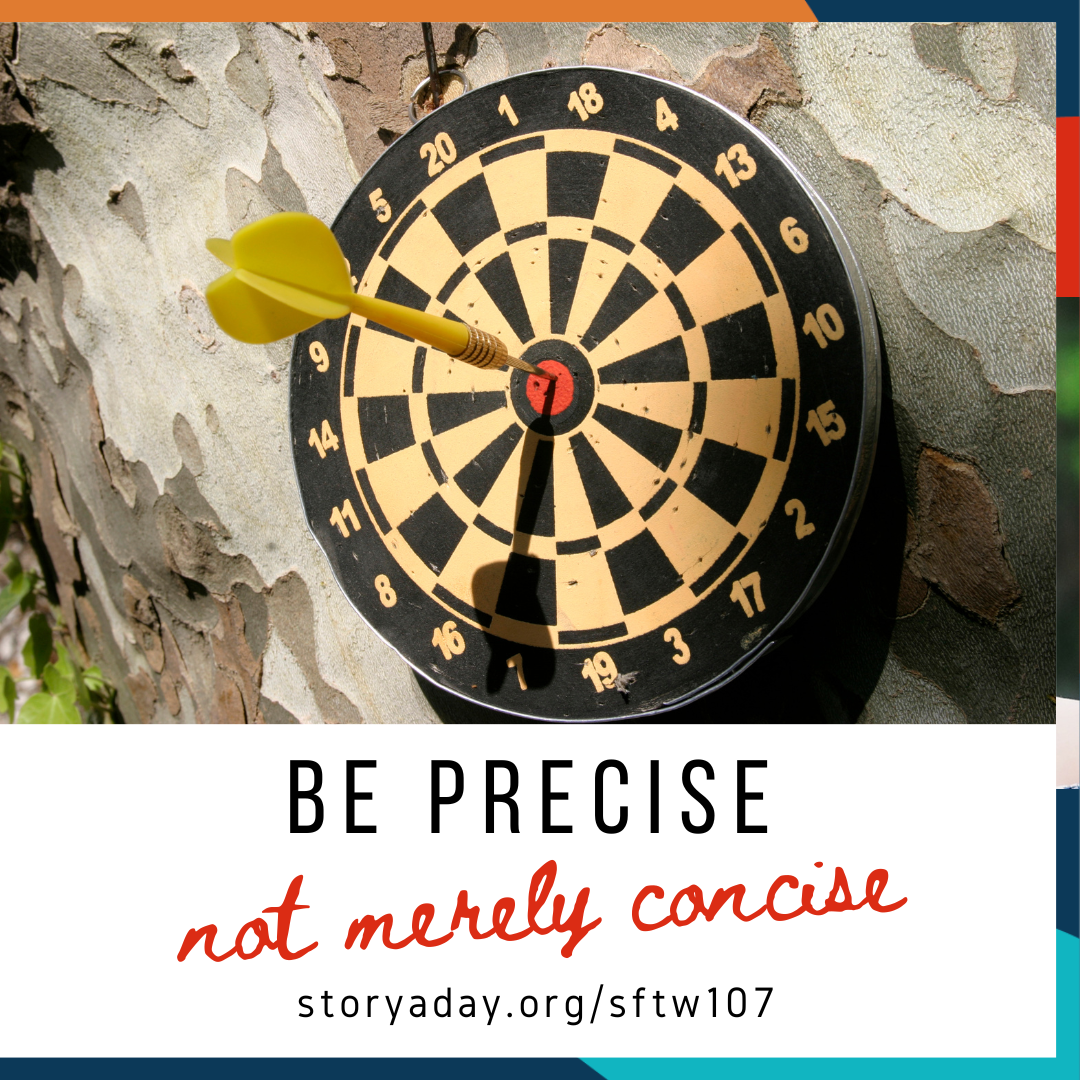
Be Precise (Not Merely Concise)

While concise writing can be a useful skill, precision is more interesting to readers.

This email is an excerpt of the Be Precise Workshop, a benefit of being in the StoryADay Superstars group. Interested? Find out more.

Sometimes when I talk about precision in writing, people worry that I want them to write in a formal, clinical, or clipped fashion. Not so!

If you want readers to be interested in your characters, you need to bring them alive. One way to do that, is to use exquisitely targeted facts about them, including showing us what they notice.

The Things They Carry

The details that characters notice and obsess about are specific to them and their experiences.

Here’s an example, in which a young research associate observes his colleagues. As you read, notice: What do we discover about how Daffyd feels about each of them, from the details he notes?

Tonner Freis—with his tight smile and his prematurely gray hair that rose like smoke from an overheated brain—was, for the moment, the most celebrated mind in the world.

“From where Daffyd stood, the distance and the angle made it impossible to see Tonner’s face clearly. Or the woman in the emerald-green dress at his side. Else Annalise Yannin, who had given up her own research team to join Tonner’s project. Who had one dimple in her left cheek when she smiled and two on her right. Who tapped out complex rhythms with her feet when she was thinking, like she occupied her body by dancing in place while her mind wandered.

-James S. A. Corey, The Mercy of Gods (The Captive’s War Book 1), Orbit 2024

Here are some exercises to keep you company this weekend, and to help you sharpen your powers of observation in writing:

  1. How does Daffyd feel about Tonner?
  2. How does Daffyd feel about Elise?
  3. If he were to approach them, what might he be feeling?
  4. Write down five precise details that give you a sense of each person and how Daffyd feels about them.
  5. Go into a passage of your own writing and try to replicate this idea: which details does your character notice about other people (or the setting), and what is it about your character that makes them choose those detail to notice?
  6. Have you used the most precise language you can, to highlight those details?

What did you discover? Join the discussion