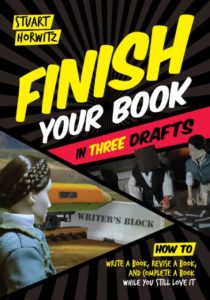
Finish Your Novel In Three Drafts: How To Write A Book, Revise A Book, and Complete A Book While You Still Love It
Every word of that title is important, so go back and read it again.
Doesn’t that sound appealing?
The first time I came across Stuart Horwitz, I was struck by the way his writing instruction bridges the gap between Pantsers and Plotters, and how he provides actual processes and methods for getting from ‘wannabe writer’ to ‘someone who can polish and finish their work’.
His latest book comes out today and provides a powerful, user-friendly guide to getting work done, while LOVING what you do.
It takes you through the process of writing a book in three drafts and includes extras like PDFs and stop-motion animated videos that illustrate the lessons in the book. It’s really delightful and powerful stuff.
I had a chance to interview Stuart Horwitz about his books, his editing work and his own writing this week, and he had some great advice for us, as we work on short stories and perhaps move on to our longer, book-length projects.
Finish Your Novel In Three Drafts. Really?
JD: Why did you want to write this particular book? What problem are you trying to help writers solve?
 SH: We only have a limited number of books in us — mostly because our time here is limited — and so it becomes a matter of figuring out what are the best books for us to work on, and how we can bring the most excitement to that work and then, how we can get through it, while we still have that energy and affection for it. (Like I say in the subtitle “while you still love it”.) And then move on to the next thing.
Time’s ticking.
And I know this very well because, little-known fact: I trained as a mortician. I walked out of there knowing for a fact that I was going to die. We all are.
Before that time comes, how about we accomplish some shit, you know? That’s all I’m saying.
JD: So how do we do that?
SH: Having a ritual while you write is crucial. There are times when it’s not possible [to fit in everything from your ritual]. We have to recognize that its value doesn’t lie within the ritual itself, it lies in its ability to bring you to a joyful state. It helps us penetrate beyond appearances and figure out why we’re doing this…what we’re doing.
And every writer has to have a process. It doesn’t have to be my process. You can get some from me, four from this other person, and make up 2 of your own and there’s your process. But if you stick to it, it will help you on the less-excited days.
PANTSER OR PLOTTER?
JD: You take a very moderate approach to the whole ‘Write by the seat of your pants’ vs ‘Outline everything’ debate. You sound terribly reasonable.
SH: We like to call it The Middle Way in Buddhism.
There’s always a reason to bend the rule and there’s always a reason to practice discipline.
KNOW WHAT DRAFT YOU’RE IN
JD: The thing that helped me immensely, every time I read your books, is the concept of “Knowing What Draft You’re In”. Can you explain that a bit?
SH: The first draft is just getting it down – The Messy Draft. The second draft is the Method Draft which is about making it make sense. The Third Draft is the Polish Draft which is about making it good.
So, when you sit down to start, it’s all First Draft.
And when you do action steps to figure out what you’re actually working with and then take the best parts up a level, it becomes the Second Draft.
And then you go through your beta-reading process, bring in outside input, and use that to get to your third draft, which is your polish draft.
And I’m talking about a real draft. I’m not talking about tweaking. Like: these five scenes are all going in trash. And: I need scenes that aren’t here yet. Adding three commas? That’s not a draft. That’s just ornamentation. That’s chasing perfection.
The secret to the three drafts is that when, during the second draft, you uncover holes and start writing that scene, remember that new scene is in its first draft. If you stare at that new piece and say, “Why aren’t you as good as everything else already?” it’s going to be madness.
Keep in mind, every time you encounter new material it’s first draft.
JD: How do you know what to work on next, in revisions?
SH: There are action steps [in his books – JD] that you can take between drafts which will reveal to you what you are working on, more clearly.
Mapping the journey we’re on at the same time that we’re on it, gets kind of dizzying/confusing.
We need a separation between the viewer and the subject matter.
I’m a big fan of grids [Here, I refer you to Stuart’s books and his website because this is a big, meaty and really useful subject – JD]
AVOIDING OVERWHELM
JD: How can a short story writer avoid overwhelm at the thought of writing a novel?
SH: I like to break it down in to writing sessions. The question is “how many writing sessions does it take”? From my own experience: I have a short story that is probably one session away from nailed and that is Number 5.
So it’s the same concept. My second book, Book Architecture Method, took 60 writing sessions.
You show up to one of those 60 sessions, you necessarily have to reduce the scope of your expectations. What am I doing today? I’m not writing a novel today. I’m writing a part of a chapter in a draft today.
I’m going to take the rest of that junk out of my mind and I’m going to sit down and write, and I’m gonna write what I was thought I was writing, and I’m going to discover new stuff, and I’m going t write stuff that isn’t good, and I’m going write stuff that is good, and I’m going to keep going, and I’m going to get to the end of this session.
When I get to the end of the session, if I’ve made progress, that’s a win.
ON WRITING WITH CONFIDENCE
JD: It’s easy as writers to judge ourselves as having failed. You idea of grids and process and ritual take the emotion out of the revision process.
SH: Self judgement is a very complex phenomenon and has many many faces. There may be a reason why that never really goes away: a tension exists where our need to constantly slay that dragon helps us bring forth our best work, or brings us to our edge. But the nagging, griping voices in our heads are, for the most part, not contributing to the forward motion.
You have to believe in yourself first. That is probably the hardest thing about writing. It’s probably one of the harder things about living, so practice in one helps with the other.
ON FINISHING
JD: I stress finishing stories during StoryADay. Your books are all about helping writers finish books. Why do you think so many writers never finish their projects?
SH: There are a lot of reasons why people don’t finish. [Sometimes] there’s some pretty deep psychological stuff going on. Somewhere there was a message that was encoded that ‘you are not good enough’.
Then the people who didn’t get that message, and who actually suck a lot worse with you, are filling up the airwaves with what they did. And now we’re having to read ten books by them before we get one book by you.
The fact is if you have 10 people who are reading what you have to say you can write something great. you can even write something great if one person is listening to you.
———————————————————
Finish Your Novel In Three Drafts: How To Write A Book, Revise A Book, and Complete A Book While You Still Love It
This book is a fabulous introduction to Stuart Horwitz’s method for writing and revising works of any length, and I can’t recommend it enough. Pick up a copy today.