[Reading Room] A Mother’s Love by Lottie Lynn

A Mother’s Love is a chilling science fiction story that was selected for the BBC Radio 4 Opening Lines series in 2014.

The stories are supposed to “”have a strong emphasis on narrative”” and this one does. Here’s the opening:

“Child wanted something to do. Mother had left him in their room, because she had to fix a pipe. He had wanted to help; but she said no, she didn’t want him to get hurt. Child thought it was because he lacked sadness whenever she left…”

I love stories like this, where no-one really explains much and you have to figure it out from the clues in the story. And I had to keep reading when, in the second paragraph, I came across this line,

“Pulling at his wires, he began to move towards the jumbled mass of objects Mother had given him to play with.”

What: wires?!

What had started out like a twisted domestic scene had taken a turn for the strange and intriguing. Note to self: breadcrumbs in stories are essential for turning it from ‘good’ to ‘un-put-down-able’.

This year’s deadline for entries is Feb 13, 2015.

[Reading Room] Cretan Love Song by Jim Shepard

This story is a lovely illustration of how to take one of those factual tidbits we often run across and turn them into a compelling and short story. It’s also written in the second person.

The author starts by writing about the Santorini eruption that wiped out the Minoan civilization 1600 years ago. He starts with an almost clinical, scientific description of what you would have seen if you had been standing on a beach on Crete at the time of the eruption. He quickly begins to introduce descriptive and poetic elements, along with people and relationships. Before long, the ‘you’ of the story has a family, and an urgent desire to fulfill.

What started out as a remote, impersonal “Imagine if” story has quickly become a heart-wrenching race to the finish that has the reader rooting for the unnamed protagonist and ends with a huge compelling message for us all.

Shivers up the spine!

This Selected Shorts episode features a great short interview with Jim Shepard who explains how his obsession with the Santorini eruption turned into this beautiful, moving story (and how it helped him in his everyday life!)

[Reading Room] Subsoil by Nicholson Baker

This story was an absolute delight: an agricultural historian is putting off getting-down-to-work on his publication with one last research trip. Feeling restless with his usual accommodations, he tries a recommended ‘bed & breakfast’ for a change….and he gets it!

I like humor and I like twists (and I love The Twilight Zone), so I loved this story. It starts with a slow burn, but the details are so delightful that you can’t resist reading on to find out what this pompous little man and his odd new hosts get up to. I get the impression the author had some fun researching obscure agricultural equipment and skewering the academic propensity to obsess over minutiae, but he does both with a relatively light hand. It’s funny but not labored, and beneath it all the mystery ticks on.

The climax is surprising and then, once you’re in on the secret, the author lets you see the ending coming; lets you unwrap it along with him as it happens. Really, really satisfying. And a little bit evil. 🙂

[Reading Room] The Old Man And The Sea by Ernest Heminway


Two confessions:

1, I’ve never read any Hemingway before.

2, I was kind of surprised to find this in collection of short stories. I had always assumed it was a novel.

Having found it however, and having been told by someone I respect that it was the worst thing he’d ever read, I HAD to give it a try.

My first impressions were that I was going to hate this. It was boring. Nothing happened. The dialogue was silted and the relationship between the old man and the boy was faintly disturbing (probably because of everything that’s been in the news recently). I didn’t care about either of them.

I Almost Gave Up

But then the old man got out on the sea and I thought, well, this is faintly interesting; I know nothing about fishing so I’ll just keep reading for a while and see what I learn.

And then, by the time the old man has chased the first school of fish (and failed) and then he sees a second school, I realized that I was rooting for him: I wanted him to succeed and I would have to keep reading to find out whether or not he did.

Reader-Hat, Writer Hat

And that, I realized, was because I had finally I started to learn some things about the old man himself. I learned them when Hemingway shared the old man’s thoughts and perceptions of himself.

From a reader’s perspective I had started to see this old man as wiry and humble and driven and, as such, intriguing.

From a writer’s perspective, I noticed that when the character had thoughts or analysed himself, or talked to himself, I learned as much from the subtext as I did from his thoughts. This is one of those “let the character say one thing and demonstrate another” lessons. It was enough to intrigue me.

Feeling Inspired?
Why not try writing a short story that focuses on character?
Use one of these writing prompts

The Stakes

And then I saw what Hemingway had done with that ‘boring’ introduction: before the old man even sets out I know that the old man is hanging on to life by a thread, that he hasn’t caught a fish for 84 days, that anyone else would have give up by now, that he is determined to succeed (will he?) and that both he and the boy want to work together again. So I had a hint about his character and I understood what was at stake. B the time he starts to fish in earnest, because I’ve come to admire the old man, I care.

(But it strikes me that readers in the 1950s must have been more patient than we are today. Or maybe he was just writing for a more literary audience and you could still get away with this if you are writing for the same audience. But most of the writing advice I read stresses the importance of making  the reader care about the character straight away, like in the first paragraph. Article upon article says it’s ‘wrong’ to start with dialogue because “Who cares?”; that we mustn’t start with the weather or the landscape, because “who cares?” Maybe that’s one of those ‘writing rules’ that we can stop worrying about so much. It depends on what genre you’re writing in of course, but if it’s holding you up from writing the rest of your story, just remember the opening doesn’t have to be perfect…ever, apparently, as long as the rest of your story works.)

On, On Through The Night

So, just as the old man fishes through the night, I read on. And I started to really care. And, then I started to despair with him. And then came the ending, which wasn’t pat or tied up with a ribbon but still managed to satisfy. I have read so many modern stories that try to ape this ‘no neat endings’ thing, but instead leave the reader unsatisfied. “The Old Man And The Sea” does not peter out. It does not end neatly. It feels like real life and we don’t know what happens next, but it does have a satisfying ending.

And I can see why this story is a bit of a masterpiece.

What a pleasant surprise.

How Was Your Writing Year?

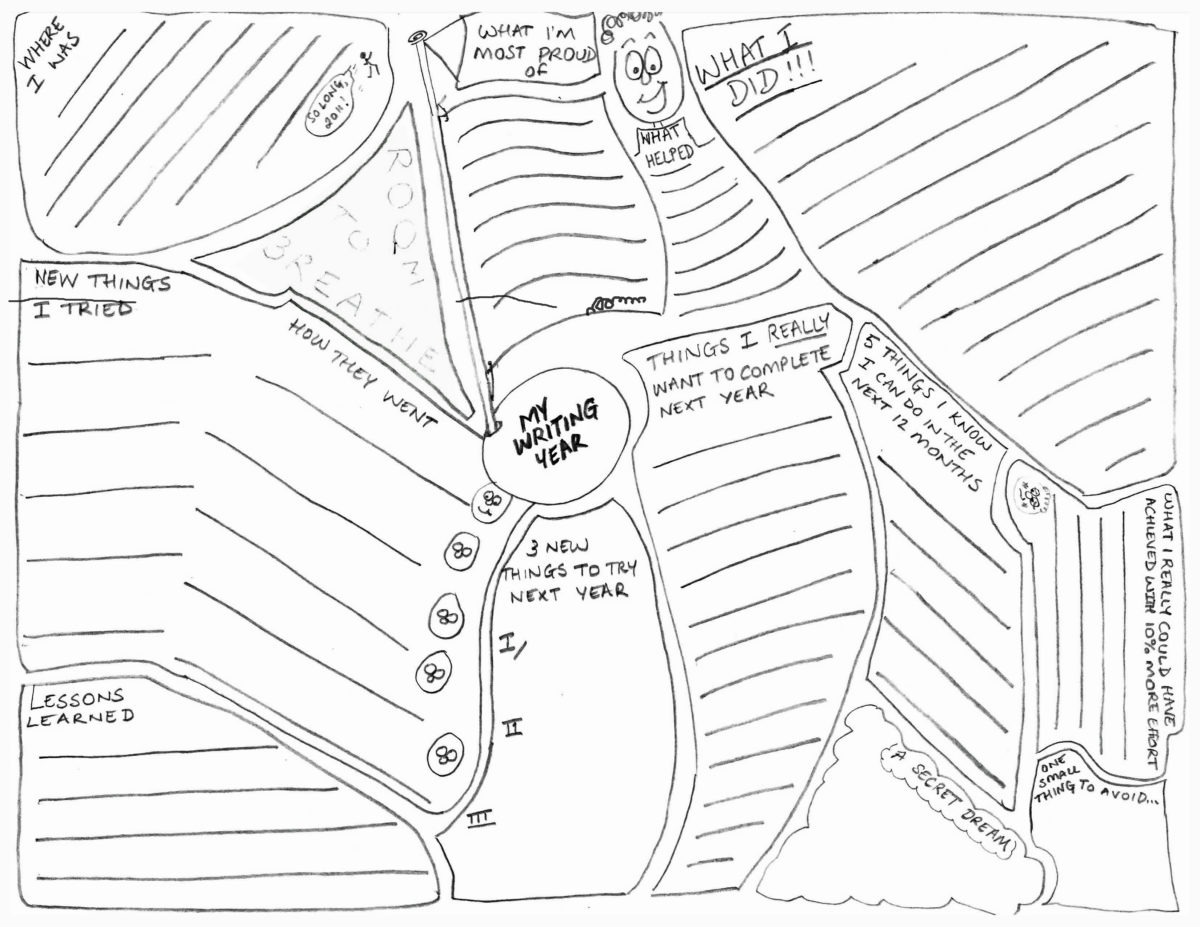
Worksheet Alert! I have a new, free worksheet for you! Take a few minutes to look back at what you’ve done this year. Spend a little time patting yourself on the back on this new worksheet for those of us who like lists but aren’t linear thinkers…[read more]

Worksheet Alert! I have a new, free worksheet for you!

We all love the New Year: the retrospectives, the ‘where are they now’s, the ghoul pools, the feeling of starting afresh and of possibilities.

Well, the end of the year is nigh and it’s time to take a look at your writing life. And I have a printable worksheet to help you do just that.


Introducing The StoryADay.org “My Writing Year” Quick Planner

It’s a one-page, 8.5″x11″ printable form without any straight lines — perfect for those of us who like lists but aren’t linear.

(If you’re not using a US printer and paper, you’ll need to check the ‘resize to fit page’ box in your printer options, but it should work out OK.)

Take a few minutes to look back at what you’ve done this year. Spend a little time patting yourself on the back as well as taking note of opportunities missed, or where you could do better next year. Capture where you were and how far you’ve come. Scribble down a few plans for next year.

Get your free copy now!


If you discover any surprising truths or want to share anything you put down, leave a comment here.

Get a free 17-page creativity workbook when you sign up for more articles like this


[Reading Room] The Fog Horn by Ray Bradbury

I came a little late to the stories of Ray Bradbury and that’s probably a good thing. I was much too literal as a teenager and probably wouldn’t have known what to make of his fantastic, thought-provoking, stories with their lyrical language.

When I did discover his writing, of course, I had my mind blown in little controlled explosions by stories like “A Sound of Thunder”, “The Rocket Man” and “The Fog Horn”.

But I hadn’t read any of his stories for years. Now, getting ready to introduce them to my own children, I picked up a collection of his early stories and sat down to read.

The very first story in the collection was “The Fog Horn”, one of my very favorites.

As I started to read, I was a little worried that I had over-romanticized Bradbury’s stories in my memory. Here were two lighthouse-keepers oiling the lamp and chatting in a fairly mundane way about their job. Maybe I wasn’t going to be as transported, at this age, as I was a decade or more ago.

Then the older lighthouse keeper tells the younger a theory he has about how the fog horn was invented.

“One day many years ago a man walked along and stood in the sound of the ocean on a cold sunless shore and said, ‘We need a voice to call across the water, to warn ships. I’ll make a voice like all of time and all of the fog that ever was. I’ll make a voice that is like an empty bed beside you all night long, and like an empty house when you open the door, and like trees in autumn with no leaves. A sound like the birds flying south, crying, and a sound like November wind and the sea on the hard, cold shore. I’ll make a sound that’s so alone that no one can miss it, that whoever hears it will weep in their souls, and hearths will seem warmer, an being inside will seem better to all who hear it in the distant towns. I’ll made me a sound and an apparatus and they’ll call it a Fog Horn and whoever hears it will know the sadness of eternity and the briefness of life.'”
The Fog Horn blew.

And that’s just for starters.

The ideas in Bradbury’s stories are wonderful and the worlds are fantastic or sometimes mundane and all of the experiences are deep and human, and the language..ah the language.

You might not love his stories the way I do, but I would recommend reading a few of them if only to see in practice this truth: you should not be afraid to write in your own voice.

Bradbury is often referred to as a science fiction writer because his most famous stories deal with rockets, and Mars and time-travel. Bradbury was writing during the ‘Golden Age’ of speculative fiction and that’s where his stories were being published – in Sci-fi magazines. But he doesn’t try to sound like his peers, nor does he limit himself to descriptions of the cold depths of space, spaceships or alien planets. He writes in an inimitable, poetic style about ideas that fascinate him in words that could only come together in that order, out of his Bradbury brain.

Go you, and do likewise.