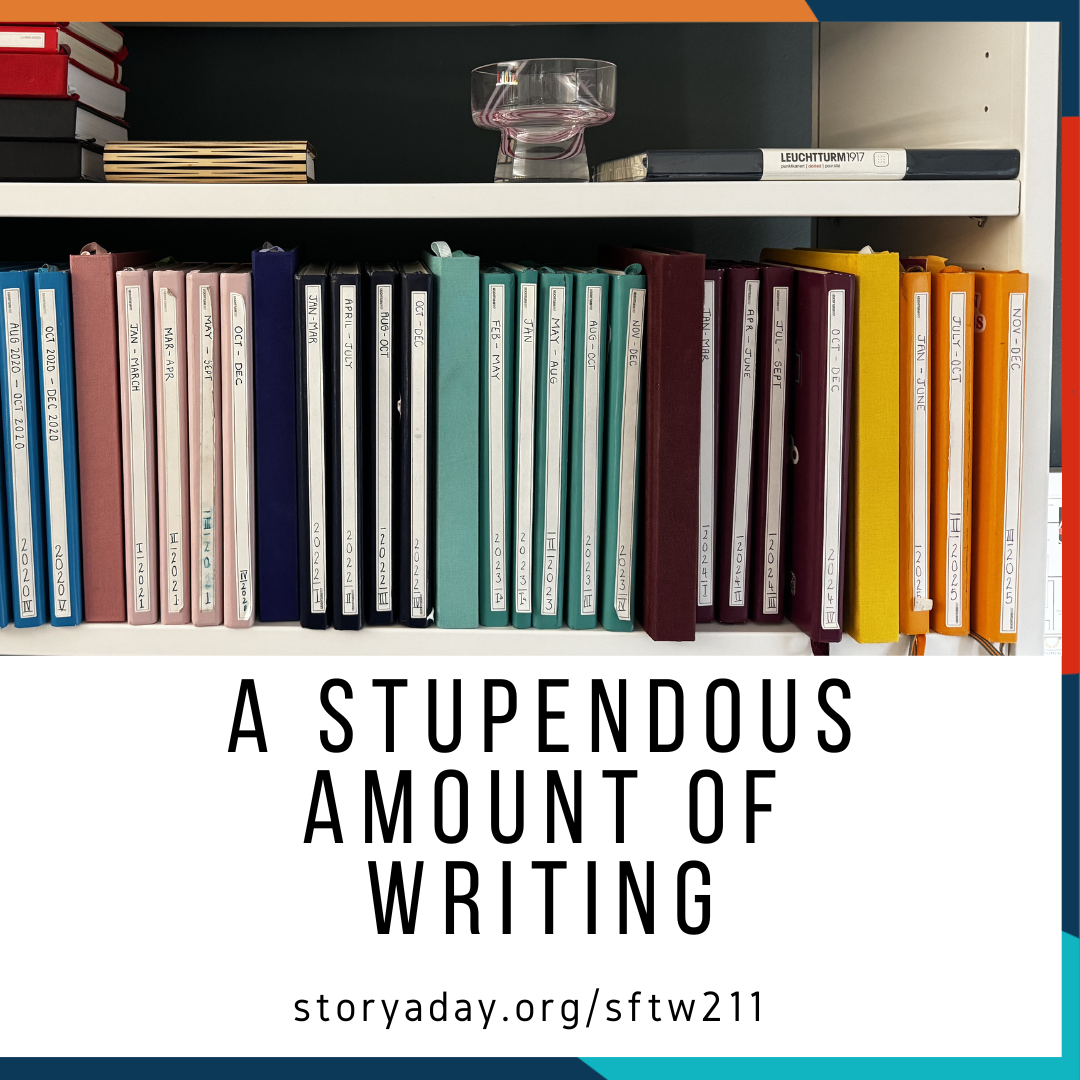
A Stupendous Amount of Writing

It’s tempting to think that other writers have it easier, or other times were easier on writers.

  • Wasn’t it easier to get published when there were more independent publishing houses?
  • Wasn’t it easier to make a living at writing in the golden age of magazine publishing?
  • All those other writers who are selling their work must have some kind of cheat code that they’re not sharing with us, right?

This week I read the editorial in the February 1951 issue of Galaxy Science Fiction magazine, a relatively new publication at the time. The magazine was making its mark, in part, by offering the highest rates in the market in order to attract the best writers. And they did—publishing Brandbury, Asimov, Clarke, Del Ray, Simak, in their primes.

But here’s a snippet from the editorial that I found weirdly encouraging. Editor H. L. Gold was trying to explain to readers how the economics of the writing business work, but I think he left an important message for us writers, too:

“Counting false starts, stories that won’t work out, stories that shouldn’t have been written at all but seemed good at the time, research, productive labor, etc., it takes a stupendous amount of writing even at the highest rates to support an author and his family on magazine sales alone.”

-H. L. Gold, Galaxy Science Fiction, February 1951

There’s your cheat code: there is no cheat code.

There’s just ‘a stupendous amount of writing’. 

Which we love to do, anyway, right?

Looking At The Wrong Metric

When people think of success as a writer, they tend to measure external, visible rewards: sales, income, awards, praise, etc.

But the rewards, if we’re honest, hit most deeply in those moment when a story draft pivots towards it’s real purpose, when you suddenly know what the story is really about; or when you realize you’ve revised it as far as you can, and it’s ready to be read by someone else.

The real reward is in the writing. 

What stalls a lot of people is the sense that you’re doing it wrong if you’re making ‘false starts, stories that won’t work out, stories that shouldn’t have been written at all but seemed good at the time…’

If you feel like you’re ‘not a real writer’ because it requires a stupendous amount of writing to generate the occasional piece that works, H. L. Gold would like a word…

He left those words in his editorial to justify paying the highest rates on the market; and they serve to remind us writers, that this was never easy. And that’s OK. 

Write a stupendous amount this week

If you’re an ambitious* writer, you have to write a stupendous amount to reap the rewards you’re after.  It’s not a race or a competition. You don’t have to burn out. But you do have to write. Probably more than is comfortable.

(*And ‘ambitious’ doesn’t have to mean ‘support myself financially via my writing’. That might be part of your ambition. But I suspect the true ambition is to do the best work you’re capable of.)

StoryADay May is an opportunity for you to find out what ‘a stupendous amount of writing’ feels like, over one month’s time. Are you capable of pushing through, writing when you don’t feel like it, and giving up on those ‘stories that should never have been written’?

If you want to feel the sharp satisfaction of success – whether that ‘success’ is ‘a day of good writing’ or ‘a story sold’, both are valid – remember that ‘a stupendous amount of writing’ is the baseline. It’s the thing that helps you find the stories, tell them well, and sense your own progress.

It’s OK if you don’t want to do all that work. If you have better things to do with your time, by all means do them.

But if you’re floating through life waiting for it to become easy I have some bad news: the struggle is frustrating, and annoying, and sometimes painful, but it’s also where the rewards lives.

What will you write, this week?

Here are the most recent prompts from the StoryADay challenge

Day 17 – A Critical Day, from Mary Robinette Kowal

Day 18 – Expanded Idioms, from Julie Duffy

Day 19 – Inspired by Artemis II, from Julie Duffy

Day 20 – Making a Grocery List, from Brenda Rech

Day 21 – The Nitty Gritty, from Ruby G. Dubois

Day 22 – The Hero of their Own Story, from Julie Duffy

Day 23 – Beyond Sound and Vision, from Elizabeth Twist

Not sure how to get started with prompts? The StoryADay 2026 Handbook has custom warm-ups and brainstorming exercises designed to catapult you into your day’s writing. Get it now
(NOTICE: PRICE WILL INCREASE ON JUNE 1, 2026)
StoryADay Challenge Handbook logo

Get the Essential StoryADay Challenge Handbook (the one that’s a short story course disguised as a challenge) from 2024. Video, audio, written lessons & captions
START HERE
Join The Fools’ Guild

Write with us this month, even if–especially if–it means you risk falling flat on your face….

Have you thought about joining the StoryADay Challenge but were too worried that you’d make a fool of yourself if you tried?

  1. What if your writing is bad? 
  2. What if you can’t write every day?
  3. What if you don’t finish your stories?
  4. What’s the point?
  5. What if you fail?

What is the point in setting yourself up for so many opportunities to fail?

OK, let’s dig in.

 1 – Let it be bad

I’m not saying you should aim to write terrible stories, but what I have learned, in 15+ years of taking on this challenge is this: a bad writing day has yet to kill me.

Don’t attempt to edit or polish what you write, the day you write it. Let it be ‘finished’, not ‘polished’.

The key is to show up even when you don’t want to. Sometimes that will result in a bad writing day. Sometimes it’ll result in a good writing day. And there’s really no way to know what kind of writing day you’re about to have. So show up.

Promise me that you won’t show your writing to anyone during the challenge. This allows you the freedom to write whatever comes. We must allow for the possibility that our writing will be imperfect, if we’re ever to get to a point where we write something halfway decent.

Success Secret: Use software like IAWriter or CalmlyWriter.com/online in ‘focus’ mode, which will ‘grey-out’ everything but the paragraph/sentence you are working on, so you’re not as tempted to edit as you go. Alternative: try dictating your story into your phone or a text-to-speech software (Google Docs has one and your phone’s Notes app probably does, too).

2 – Make Your Own Rules

I say ‘StoryADay’ – and if you can swing it, it will absolutely bust through all the lies you are telling yourself about how much/often you are able to come up with an idea, and reduce it to practice.

But…

I long ago discovered that I hate writing every day during this challenge.

Seriously. I always take a day off every week during the challenge. Because otherwise I’m miserable. I made it a personal rule (I take Sundays off).

Some years I have encouraged people to rewrite their own rules after every 7 days of writing, to take into account what they have learned. 

Make rules that will push you to write more than you would have otherwise. Make rules about what ‘every day’ looks like; about what ‘a story’ is; about what ‘finished’ means; and about how often you’re allowed to change the rules during the challenge (I do recommend that you only allow rules tweaks at the end of each week, or every other week…)

And if you are a person for whom streaks are extremely motivating, take that into consideration too. Commit to writing a story every day, even if some days that means you’re writing a 6 word story or 6000 words of stream-of-consciousness experimental babble.

Success Secret: Don’t go it alone. Come over to the blog each day and check in with the StoryADay community, in the blog comments, to let us know how it’s going.

3 – Practice, Don’t Chase Perfection

I always recommend trying to put some kind of ending on your story every day. It feels good. I trains your brain to push through the messy middle and not just chase the next shiny idea.

But that doesn’t mean the story needs to be complete or polished. There may be parts that don’t make sense, or that can be expanded, or where you have written “[history’s most romantic kiss goes here but I don’t feel like writing that today]”.

But do Future-You a favor and put some kind of ending on the story while it’s still ‘hot’, and you still have a sense of what you want it to be about.

(I come back to StoryADay Challenge drafts all the time when I’m looking for my next short story to polish and send out into the world. It really helps when there’s a substantial story there, no matter how imperfect!)

Success Secret: Use the energy of the community to keep you going, when the novelty has worn off. Come to the blog every day and comment on how your challenge is going, and cheer on the other people who are participating. Humans are social creatures (yes, even the introverts) and we’re not meant to do big things alone. So don’t try! Join us.

4 – 13 Reasons to Try

I’m asking you to write fast, messy drafts and move on every day. Why bother?

  • It proves to your inner editor that you can write whether or not you’re inspired when you sit down
  • It proves to you that you can write today, even if you felt like the world’s worst writer, yesterday
  • It makes you more decisive (in your everyday life as well as your writing). Writing is all about stage-managing every choice in your fictional world and for your characters. You have to get good at making decisions, and quickly!
  • It allows you to try out voice, personas, genres, forms and random ideas that you could never justify the time for, if every idea had to turn into a finished product. Sometimes these experimental wanderings reveal a new voice or genre that you can happily spend years with, after the challenge (it happens!).
  • It reminds you that you are a writer, that you have some aptitude with words, and that you deserve to make time in your life for writing. 
  • It reminds you of how it feels to be a writer (who is writing).
  • It makes you think deeply about issues and people. This means you are more compassionate and creative when it comes to problem-solving in the rest of your life.
  • You are easier to live with when you take some time to do the thing that makes you feel most like you. (Trust me. My husband just came home from his office and commented on how happy I seem, today. Guess what I’ve been doing this afternoon? Yup, writing!)
  • It gets you off social media, and gives you space to decide where your attention goes, today. 
  • It allows you to do some ‘deep work’, which changes the way your brain works, creating more space for brilliance.
  • It changes the way time flows for you. An hour spent writing in your story world feels very different from an hour spent scrolling short videos on random topics.
  • People love it when they hear you’re a writer (When new people meet me and my husband, what are they more excited about: the fact that he designed two drugs that are on the market and making people more healthy, or that I’m a writer? It’s ok, he’s not bitter…). It doesn’t matter if you have a best-selling book or if you’re ‘just a writer’. It inspires people to think about what they could be doing, if they would just let themselves…
  • You’ll regret it if you put it off, any longer. We don’t have an infinite amount of time in this existence. Let’s have some fun with what we have!

Success Secret: Celebrate every tiny triumph. Opened your laptop? Triumph! Read the prompt? Triumph! Wrote some words? Oh my goodness, you’re heroic.  Celebrate every step on the road to a prolific writing habit with a literal pat on your own back, a dance party in the kitchen, or anything else that makes you smile and triggers the reward-circuits in your brain. Do it immediately and often, and create those reward-pathways that make your brain whisper: hey, isn’t it time to get back to your writing?

5 – What if you don’t even try?

Failure is how we learn. 

If you can’t fail, you can’t get better, and you’ll spend your whole life envious of people who seem ‘luckier’ than you.

If you can’t face failing, you’re going to be stuck–and very sad–for the rest of your life. 

Failures provide useful data:

  • You might think that you love writing at midnight only to discover that your 52-year old self cannot work the way your 25-year old self did. Good data. Now you can work on finding a time that does work. Why not start experimenting, tomorrow?
  • You might think you love writing romance only to discover that you there’s a dark-thriller writer inside, longing to break free and slash things.
  • You might think that you can write 5,000 words every day because you did that one time, in a caffeine-fueled deadline-driven binge. Discovering that you can ‘only’ manage 300 words in a single session before your brain turns off, is useful, and allows you to schedule three 20-minute sessions tomorrow and be delighted by your 900 word story, instead of being disappointed you ‘only’ wrote a flash fiction piece.

Success Secret: Treat everything as an experiment.

So grab your lab coat from the coat rack, put on your safety specs, and join me in the Creativity Lab, for StoryADay November.

Adventure beckons.

 Discoveries await.

Join us!

Keep writing,

Julie

StoryADay November 2025 participant badge

To Do Now

  • Decide now, that you’ll join us in StoryADay November. Sign up here
  • Pick a number of days that you will participate. Post your goals here 
  • Leave a comment below, confessing your remaining fears (and let me reassure you)

And I’ll see you in the comments, next month!

P. S. Want more support, including daily writing sprints, monthly discussions, workshops, Critique Week and more? Consider joining us in the StoryADay Superstars. Find out more…

Failure Is Not Optional

What I learned about writing from the Phillies crashing out of the World Series race…

I’m a fan of the Philadelphia Phillies baseball team.

(Thank you for your condolences. Visiting hours will be between 6 and 8 pm)

One of the things I love about baseball is the fact that it’s not over until it’s over, when suddenly, nail-bitingly, it is.  (Like last night. Ugh.)

But as I’ve become more of a fan of the game, other lessons have become clear that I think we writers could do with pondering.

Failure is A Big Part Of The Game

Everyone says ‘you have to get lots of rejections to get published’, and that ‘shitty first drafts’ are part of the process, but I don’t think we give enough energy to learning to love those realities.

In baseball:

  • Elite players fail 70% of the time they step up to the plate.
  • Failing 75% of the time impresses nearly everyone..
  • The league’s worst hitter this year failed 80% of the chances he got (and hasn’t been fired).

These players keep striving even when the game is this mean to them.

Where’s The Hole I Can Crawl Into?

The Phillies’ 2025 World Series dreams ended on a rookie mistake—a horrifying, painful, embarrassing flub by a young pitcher, who made the wrong split-second decision.

In. Front. Of. Everyone.

Then he had to go out and talk to the press about it, afterwards.

I’m not sure I could have done that.

Of course, the media-trained young pitcher said all the right things like, “this sucks right now”, “get over this hump and keep pushing”.

City of Brotherly Grit

I hope he can find the resilience and courage to do that in the face of humiliation and doubt (and the famously vocal Philadelphia fans), even if he has to borrow that grit, occasionally, from the people around him.

If he can, I believe he will be extraordinary, as a player and as a human.

Selfishly, also I hope he succeeds because I need regular, visible reminders that this kind of determination is possible. I’d love him to be my model of how the pursuit of excellence requires courage and resilience and a willingness to carry on in the face of failure and even humiliation.

What It Takes

If that young player thrives, it’ll be down to:

  • The years of practice at failure and rebounding that already lie behind him 
  • Continuing to hone his skills, even as a professional
  • The support of a team (of family, friends, colleague, and coaches) who shepherded him through those early years and the team he has around him now who will help him get better and keep his chin up
  • The inner work he continues to do to master the discomfort of striving for excellence

Sounds like a good plan, in sports, life, and writing!

You’ve Got This

This week, if you want to:

Practice A Lot: consider Writing A Holiday Story, taking the 3-Day Challenge, or sign up for Writing Prompts & Lessons every week for a year

Work on Your Skills: Follow along with the StoryADay Challenge warm-up tasks

Rely On Your Team: consider joining our upcoming Critique Week (registration opens on Sunday). You’ll have a team of supportive, experienced players to help you see your story clearly and keep your chin up.

Work on Your Inner Game: consider booking a “Writer’s Therapy” coaching session with me.

Keep writing,

Julie

P. S. Have you signed up for the StoryADay November Challenge yet? Remember: set your own rules, and then use the community to help you stick to them!

Join The Discussion

Do you have a lot of resilience around your writing? Do you wish you had more? Do you ever (go on, admit it) resent the fact that things seem so hard? Leave a comment and let us know.

Ready to turn those sparks of wonder into finished stories?

StoryaDay 3-Day Challenge

Take the 3-Day Challenge and write three short stories this weekend!

Take the 3-Day Challenge — a short-story writing course you can finish this weekend. Go from “idea” to “The End” in three days, and give yourself the gift of an achievement you can celebrate.

Create A Bounce Back Plan

…because setbacks happen.

Every writer hits bumps—on normal writing weeks and especially during a challenge. The trick is to bounce back, quickly.

If you think the point of a challenge like StoryADay is to turn out 31 stories in 31 days then, well, you’ve kind of missed the point.

The real point of StoryADay May is to allow you to teach yourself how to be a writer on good days and bad.

Everyone ‘fails’, when writing. Sometimes that means going for days without writing anything. Sometimes that means writing something you’re not happy with. Sometimes it means not achieving what you set out to do.

But the places where we fail are the places where we learn something interesting: about our habits, about our capacity, about our skills, and about our ability to control our responses.

Your response to a failure should never, ever be to give up.

You can rest. You can reset, but you must not quit.

Today’s tiny task is to:

Create Your Bounce Back Plan

What will you do if you don’t meet your goals for a day during the challenge?

  • Make a list of all the things that might go wrong on any given day in during the challenge,
  • Then, come up with contingency plans. Think of ways to jumpstart your writing, create a gap in your schedule, or perhaps even a ways to forgive and forget, and move on.

Examples

If your goal is to write a short story every day in May and one day you fall asleep before you write your story, how will you respond? Will you—as I strongly recommend—shrug it off and move on to the next day, not going back to ‘catch up’? Or will you allow your subconscious plan to kick in? You know, the one you haven’t acknowledged, but that is secretly lurking there? The one that says “oh, well, I blew my streak, I should just quit and wait for next year?”. Hint: Dont’ do that. Make a proactive, resilient plan like the one I suggested.

If you are failing to get a full story written, because you’re stuck, or because it’s late and you’re tired, what is an acceptable minimum alternative? Will you write a well-crafted 6-word or 100 word story instead of the story you thought you were going to write?

If you hate the day’s prompt but don’t have any ideas of your own, will you skip that day and do something to fill the well (like reading a short story, or going to an art gallery) and call that a win? Or will you have a stash of ‘back up prompts’ from the StoryADay archive to draw on? Or perhaps you’ll dig into your Story Sparks and notes from this month’s warm-up exercises and come up with a story that surprises and delights you, instead? What’s your plan for days like this, when inspiration doesn’t strike straight away?

If you discover that you hate writing at whatever time you had planned out for your StoryADay writing, will you quit? Or will you commit to trying to write at a different time for a few days and see if that shakes anything loose?

If your laptop makes your eyes hurt, or your favorite pen breaks, or you just can’t stand looking at screens anymore. Will you try dictating your story into your phone? Or typing it on an old typewriter?

If you discover you crave a day off, do you have to quit the challenge, or do you decide to give yourself Sundays, or Wednesdays, off? Maybe both? (Full disclosure: I take Sundays off, because otherwise I feel miserable by Week 3.)

Discussion

What is your Bounce Back plan for days when things go awry?

How To Fail At Story-Telling

“What if my stories are no good? What if I fail?”

This is possibly the most powerful thing holding us back.

We can find or make time if we really want to. Even if the power lines went down and the world ran out of paper, we could tell our stories out loud, around campfires as of old.

The most insightful of us understand that success brings its own stresses and that worries us.(Imagine if your first novel was a best-seller. Where would you go from there?!)

But the thing that really stops us?

Fear of failure.

Good News! Failure is Good For You!

Continue reading “How To Fail At Story-Telling”