Build Better Characters (Today, Not ‘Some Day’!)

Or: Be Your Own Casting Director

Listen to the podcast episode that inspired this post

Readers don’t fall in love with stories because of clever twists or thrilling events. They connect because of characters—flawed, funny, furious, fragile characters who make us feel something. 

If you want to improve your writing—and your readers’ response to it—mastering character creation is one of the most satisfying ways to do it. 

But I don’t want you to go and read a book about character (David Corbett’s “The Art of Character” is great, but at 380 pages, will not leave you much time to write, this weekend). 

So here are some practical ways to think about and craft characters that leap off the page and grab your reader by the heart. 

And you can get started by building a stash of character building blocks, this weekend.

Why Character Matters

Characters are the heartbeat of your story. They don’t just exist in a setting or respond to a plot. Nope. They drive the plot. 

Every decision a character makes causes ripples. They mess things up, fix them, sabotage themselves, fall in love, hate the wrong person, take the wrong job, say the wrong thing at the worst time—and that’s what creates story.

Thankfully, you don’t have to invent every character from scratch on the day you sit down to write. (That’s a guaranteed way to find yourself staring at a blinking cursor for 45 minutes and then convince yourself that doing laundry counts as productive procrastination. It doesn’t. Nice try.)

Instead, do yourself a favor: build your characters now Then dip into this little treasure chest any time you’re short on inspiration or just need a quick-start push.

Start With What You Know

Your first batch of characters? Make them like you.

Yes, you. The person reading this. You are the perfect inspiration for at least five characters. And no, they don’t have to be “you” in the obvious ways.

Start a list of five characters who share something with you:

  • Hair color? Sure.
  • Your love of spreadsheets? Perfect.
  • Your ability to cry at pet adoption commercials? Gold.

You can use your own internal traits too: your introversion or extroversion, your conflict-avoidance, your snarky sense of humor, your perfectionism, your unshakeable optimism, or the way you freeze up when someone asks where you see yourself in five years. All of it is fair game.

These characters are easy to write because you’ve lived in their skin. So when you’re stuck and short on time, they’re your go-to. Let them loose in your stories.

Bonus points: Write down which of those traits delight and frustrate you. That’s where the conflict lives. That’s where the story is.

Characters NOT Like You

Made your “like me” list? Great. Now, do the opposite.

Write down five characters who are unlike you. These are the ones who baffle or irritate you, or maybe the ones you secretly wish you could be. Pick traits you don’t relate to:

  • Someone who’s smooth-talking
  • A fearless adrenaline junkie.
  • A meticulous rule-follower.
  • Someone who thrives in social chaos while you’re ready for a nap after five minutes of small talk.

Think about how these traits might cause trouble—or create strength—in a story. How does an overly confident character screw up a sensitive situation? How does a shy person save the day because they notice what everyone else misses?

Again, note the conflict potential. Conflict = story. Always.

Add Color

Characters aren’t just about personality. Let’s dress them up a bit—literally.

Make a list of ten accessories or physical features that a character might have. These details are powerful shorthand in short stories. You don’t always have space to dive deep into every side character’s backstory, but you can make them memorable with:

  • A red umbrella with a duck-shaped handle.
  • A constantly rumpled trench coat.
  • Neon-green glasses.
  • A nervous habit of jingling keys.

These are little anchors for your reader’s brain. They give your stories color and texture—so everything doesn’t start to feel like a blank-stage play with floating heads and indistinct voices.

(There are useful for main characters but also a great way to make a secondary character pop.)

Get Quirky

Personality traits can show up whether your character wants them to or not. These are the reflex reactions, the annoying habits, the self-sabotaging instincts that make people people.

Think of five traits that drive you bananas in real life (or delight you—if you’re feeling generous). Use those.

Maybe your character:

  • Always expects the worst.
  • Can’t say no.
  • Over-apologizes.
  • Constantly tries to “fix” people.
  • Never sees the good right in front of them.

Then for extra credit, jot down how each trait might be subverted in the story. Turn the annoying trait into a strength. Make it a liability that forces change. Or let it spark unexpected humor.

Let Them Speak

Finally, give your characters their own voice. Not just dialogue—voice.

List five expressions or phrases people in your life overuse. Think of the office cliché machine, your grandmother’s weird sayings, or the barista who always says “rock on” no matter the situation.

Give each character a verbal tic. Let one say “bless your heart” with venom. Another can end every sentence with “you know what I mean?” even when no one does. These quirks do double duty: they reveal character and make your dialogue sparkle.


Don’t wait. Make these lists this weekend.

Stop waiting to get “good enough” to write great characters. You already have everything you need: your quirks, your annoyances, your people-watching superpowers. 

Use them. 

Make your lists. 

Keep them handy.

 And when it’s time to write—today, not someday—you’ll be ready.

Make a mess. Have fun.

And, of course, keep writing.


If you loved having prompts turning up in your inbox, but would like to go at a more leisurely pace, consider subscribing to my
StoryAWeek newsletter:
52 lessons and writing prompts, weekly for a whole year!

StoryAWeek Logo

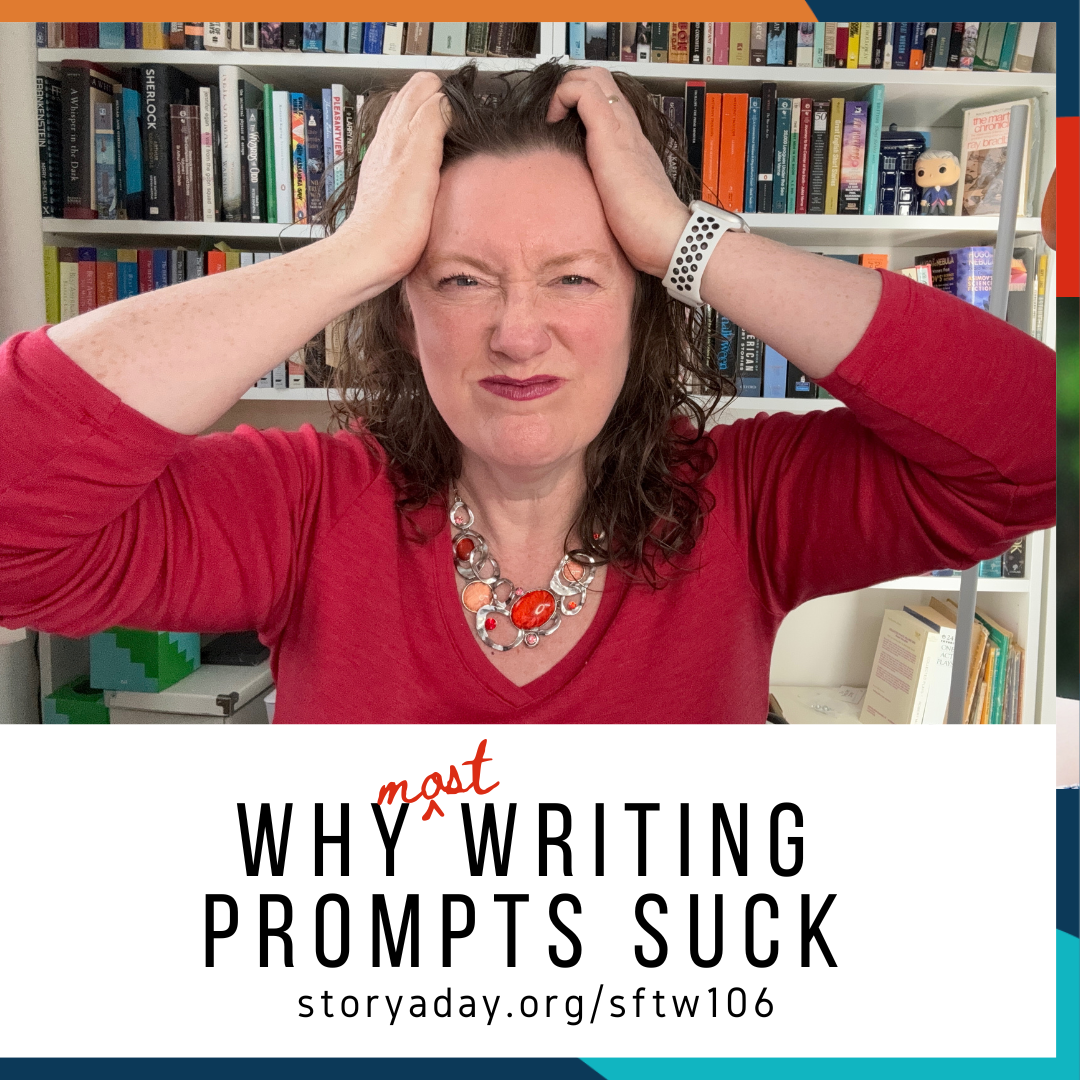
(Why Most) Writing Prompts Suck

Most free writing prompts suck…and worse than that: they waste your time and energy. Here’s what to do instead…

Last year I excitedly signed up for two different ‘a year of free writing prompts’ from sources I have turned to for writing inspiration and instruction for decades…and every time I open the weekly email, they make me sad.

The prompts kind of suck.

They feel worth what I paid for them: nothing.

In fact it’s worse than that. The cost isn’t 0.

The cost is my time and energy, spent opening the emails, looking at the prompt, and losing a little more hope every week.

Every time I see an offer for one of those free prompt subscriptions, I feel like I should sign up, if I’m serious about my writing. Shouldn’t I be doing everything I can, to advance my writing.

If you feel the same way, let me help you out: no. You should feel no guilt about walking away. Why?

It’s Not You, It’s Them…

Maybe you’re like me: I’m a lifelong journaler who doesn’t need prompts to journal. Many people throw out ‘writing prompts’ that are really just instructions to ‘write about a time when you…’. 

There’s little direction about how to make that writing time useful, or ways to develop your skills, and really, what writer needs more ideas?!

Or maybe, like me, you’re a short story writer or novelist.

While you can use journaling prompts to hone your description and dialogue skills, wouldn’t you rather be doing that while writing a story? For some reason, few writing prompt writers bother to spark actual stories.

Some writing prompts give you a genre, a character, and an object and tell you to write a story from that.

But, while that might help you come up with a premise for a story, there’s more to a story than that. For example,

  • How do you decide what the character wants? 
  • How do you know what the character decides to do with the object?
  • Why does the object matter?
  • What are the genre norms?
  • Do you even want to write in that genre?

Does the prompt help you think about any of these things? Rarely.

Ideas are easy. Crafting them into a compelling piece of writing is the part that matters. And it’s frustrating when a prompt leaves you high and dry.

Frustrated No More

If you’ve found writing prompts as frustrating as I have, I have an invitation for you, this week, and that’s to check out a free sample of my StoryAWeek newsletter.

In 15 years of running StoryADay May, I’ve learned a lot about what helps writers to start and finish stories. 

And it’s more than giving you a simple idea or a premise and saying, ‘good luck with that! Seeyabye!”

It’s also 

  • Supplying brainstorming questions to help you find a way into your writing
  • Teaching craft and writing-practice techniques in bite-sized chunks, tailored to the prompt
  • Sharing examples of stories that exemplify the best of the craft
  • Sending words of encouragement, that help you remember you’re not alone, and that you can do this. Of course you can!

A prompt should, er, prompt you to write. It should inspire you; spark connections in your brain; send you scurrying to the page, eager to craft a new piece of writing.

Torturing A Metaphor

Prompts that give you ideas for fragments are like plastic pony beads you buy from the craft store: 

  • Mass produced
  • Colorful, but uniform, inspiring nothing unique
  • Not something that often contributes to creating a valuable finished object.

A prompt that inspires you to craft a written piece readers will enjoy, is more like a natural pearl: 

  • Created by a slow but reliable process, 
  • Subtle in its variation as you hold it up to the light of your imagination 
  • a treasure that can be used to create other treasures.

Am I over-selling the importance of NOT wasting your time and energy on crappy writing prompts? 

Forgive me. I feel strongly about this.

You don’t have to subscribe to the StoryAWeek Newsletter (52 weeks of hand-crafted, lovingly spun writing lessons, prompts and letters of inspiration taken from my years of experience), but I hope you will at the very least give yourself permission to walk away from all those worthless writing prompt offers, and trust your own writerly instincts.

If you are looking for a weekly reminder to sit down with your writer-self and develop some new stories and scenes, delivered to your inbox, please do consider the StoryAWeek Newsletter

StoryAWeek Resources – Season 1 Week 9

If you’re following along with my StoryAWeek newsletter we’re talking about location this week.

Here are some links to things I talked about in the email.

Million Dollar Outlines by David Farland

Nightmare at 20,000 Feet by Richard Matheson

All links above are Amazon affiliate links

From Short Stories To Novels — And Back Again

Short stories and novels are different beasts, but there are skills that transfer between them, both in the craft and in the writing life.

This week I’m talking about something I learned about the writing process, in my own writing this week. You might be surprised…  

LINKS

Sign up for the Fun-Sized StoryADay September Challenge

Join the StoryAWeek private newsletter here

Endlessly Inspired

This week we take a look at the publishing industry, your goals, and how you can become endlessly inspired and creative…

Learning about the realities of the publishing industry can free you to create your own definition of success (that may or may not include traditional publishers). Step 1 towards success is to imagine your vision. Step 2 is to turn up for your writing, something the new StoryAWeek newsletter can help with!

For industry perspective: Jane Friedman’s The Hot Sheet: https://hotsheetpub.com/

Leave a comment about this episode: https://storyaday/episode259

StoryAWeek Newsletter Logo